Oxford, Miss. – The University of Mississippi has become the first school in the state to roll out a campus‑wide food‑waste recycling system that relies on black‑soldier flies, a tiny insect native to Mississippi, to produce compost for campus gardens and ecology projects.
Partnerships and funding
The effort is a collaboration between the university’s Office of Sustainability, the Mississippi Department of Environmental Quality (MDEQ) and Aramark, the university’s food service provider. A $50,000 grant from Aramark helped convert the Biology Department’s greenhouse on Vaught Lane into a breeding and processing facility for the flies.
How the system works
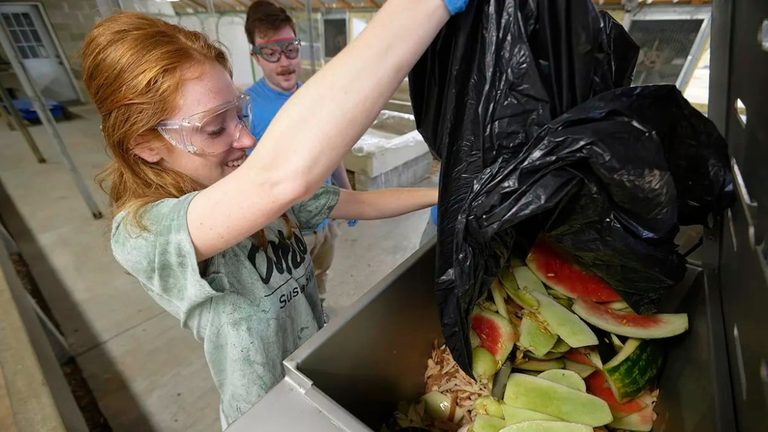
Black‑soldier flies are non‑disease‑carrying insects that feed on organic waste. Their larvae consume food scraps, rapidly breaking them down into a high‑quality, nutrient‑dense compost. The university plans to recycle one ton of food waste each month initially, with a long‑term goal of reaching up to ten tons per month as the program expands.
Both adult flies and larvae are also used as feed for insect‑eating livestock and pets, adding another layer of sustainability to the project.
State support and regulatory development
“Our goal was just to reduce food waste on campus, but because this is the first of its kind in the state, MDEQ will build the regulatory process based on what we create,” said John Brugge, director of the Office of Sustainability. “We’re helping develop these processes for Mississippi, and we want to build a process that any farmer in Mississippi can replicate.”
Jennifer Wells, state recycling coordinator at MDEQ, noted that the department is still revising regulations to accommodate new composting methods. “We have authorized composting facilities throughout the state under a pilot program, but Ole Miss’s black‑soldier‑fly facility is something we have not encountered before,” she said. Wells described the university’s effort as “a research project of sorts,” indicating that the state will work closely with the university to shape future composting mandates.
Environmental impact
The U.S. Food and Drug Administration estimates that 30‑40% of the nation’s food supply is wasted each year. By diverting campus food scraps to the fly‑based compost system, Ole Miss aims to reduce landfill waste, lower greenhouse‑gas emissions associated with food decomposition, and provide a locally sourced fertilizer for its own landscaping and educational projects.
University students and staff are actively involved in the program, from breeding the flies to managing the compost output. The initiative also serves as a hands‑on learning opportunity for biology and environmental‑science students.
Looking ahead
With state agencies monitoring the project and the university refining its processes, the program could serve as a model for other schools and farms across Mississippi. If successful, the regulatory framework developed alongside Ole Miss’s pilot could make it easier for other institutions to adopt similar insect‑based composting solutions.
For more information about the black‑soldier‑fly composting project, visit the University of Mississippi’s Office of Sustainability website.
Original reporting: Action News 5 WMC (Gray) — read the source article.