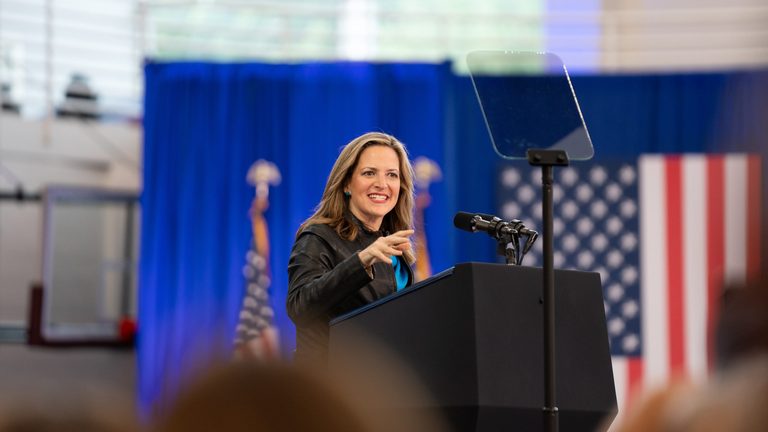
State Democrats in Lansing are treating the Michigan Voting Rights Act as their flagship initiative for the upcoming legislative session. After regaining full control of the governor’s office, the House and Senate, they say the four‑bill package will finally move forward.
Leadership signals strong commitment
Secretary of State Jocelyn Benson, the state’s top election official, told voters the act would be the first bill she signs if elected. House Speaker‑elect Ranjeev Puri expressed “a lot of interest and excitement” among House Democrats, while Senate Majority Leader‑elect Darrin Camilleri called the proposal “very high on my list of priorities” once the Democratic trifecta takes effect in January.
What the four bills aim to do
The package is designed to fill gaps left by the federal Voting Rights Act, which has been eroded by recent court decisions. The first bill would ban discriminatory voting practices, require advance notice of changes to polling places or precinct boundaries, and give courts the power to appoint election monitors and veto certain election‑related changes.
The second bill proposes the creation of a state‑run voting and elections database at a university, providing public access to precinct‑level results and registration data.
The third bill would require jurisdictions to provide translated voting materials in communities where a significant number of voters speak a language other than English. It lowers the threshold for translation requirements, extending coverage to languages such as Arabic, which is Michigan’s third‑most‑spoken language.
The final bill focuses on voter convenience and accessibility. It codifies curbside voting, allows voters with language barriers to bring personal translators, and permits volunteers to offer food, warmth, or other necessities to voters waiting in line. It also mandates disclosure when officials remove voters from the rolls or make other administrative changes.
Past attempts and recent progress
The act was first introduced in 2023 when Democrats controlled the Senate, House, and governor’s office. Although the Senate passed the bills in September 2024, they stalled in the House during a chaotic final month of the session. A renewed effort in 2025 saw the Senate approve the package in June, but the Republican‑controlled House again blocked advancement.
Now that Democrats hold both chambers, supporters are optimistic. Legal counsel for the Campaign Legal Center, Marisa Wright, says the act would position Michigan as a national leader in protecting the fundamental right to vote.
Broader context
Michigan would join a growing list of states—California (2002), Illinois (2011), and a dozen others—all controlled by Democrats, that have enacted their own voting‑rights statutes in response to the weakening of federal protections. As a swing state, Michigan’s adoption of such a law could have outsized influence on future presidential elections.
Voter turnout in the 2026 midterms reached 60 % of voting‑age residents, tied for the highest in state history, a rise attributed in part to recent expansions such as automatic registration, no‑excuse absentee voting, and Election Day registration.
What remains to be decided
Critics have not yet offered detailed alternatives, but the Democratic leadership acknowledges that the bills may be tweaked before formal re‑introduction in the 2027 session. If passed, the act would reinforce Michigan’s decade‑long trend toward broader voting access while providing state‑level tools that the federal framework no longer offers.
Original reporting: BridgeDetroit — read the source article.