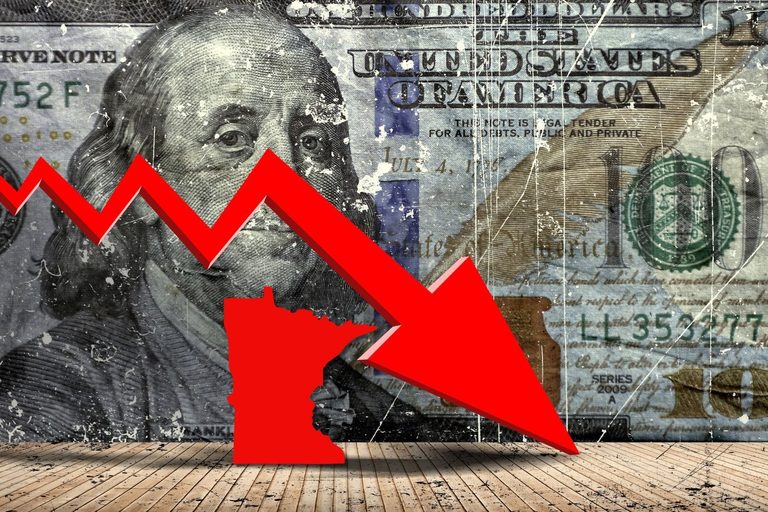
The Minnesota Chamber of Commerce released its 2027 Business Benchmarks Report, warning that the state’s economy is falling behind almost every other state. The study placed Minnesota 49th out of 50 in GDP per‑capita growth for the 2019‑2025 decade, a stark drop from its historically strong performance.
Key findings from the report
According to the report, Minnesota ranks 43rd in per‑capita income growth, 46th in average wage growth, 47th in median household‑income growth, and 45th in export growth since 2019. Labor‑force growth and employment growth also lag, with the total labor force falling below January 2020 levels in 2026.
Annual per‑capita economic growth averaged just 0.4% from 2019 to 2025, and the pace has nearly stalled since 2023, slipping to only 0.1% between 2024 and 2025.
Chamber leadership’s perspective
Doug Loon, president and CEO of the Minnesota Chamber, told The Center Square that the state is “largely stalling out right now.” He cited slowing population growth, an aging demographic, rising business costs from taxes and regulations, and declining investment as primary factors. International migration remains the only driver of population growth, while domestic migration shows a loss of nearly 40,000 residents.
“We’re not growing at the rate we once were, so therefore we’re not growing our workforce,” Loon said. “We’re also seeing investments not coming to the state at the rate we once saw.” He expressed hope that the report will spur meaningful change, noting that Minnesota once enjoyed a very strong economy that far exceeded much of the nation.
Republican response
House Republican Leader Harry Niska, R‑Ramsey, called the findings a “flashing red warning light.” He urged immediate action: “We need to reverse course, lower taxes, rein in government spending, and make Minnesota a state where businesses want to invest, expand, and create jobs.” Niska warned that the state is “getting dangerously close to the point of no return.”
Political context
Governor Tim Walz, a Democrat, has not yet issued a public statement on the report. The partisan divide underscores the broader debate over how best to stimulate growth—whether through tax relief and deregulation, as Republicans advocate, or through other policy tools favored by the administration.
What this means for Minnesotans
For families and local communities, slower economic growth translates into fewer job opportunities, stagnant wages, and tighter municipal budgets. The Chamber argues that a revitalized business climate would benefit not only companies but also households, schools, and local government services.
Stakeholders across the state are watching closely as policymakers consider how to address the report’s stark conclusions. The next steps will likely involve legislative proposals aimed at cutting taxes, reducing regulatory burdens, and attracting both domestic and foreign investment.
Looking ahead
While the data paint a sobering picture, the Chamber’s leadership remains optimistic that Minnesota can reclaim its economic momentum. “If we can unleash the strength of our business community and move towards reaching our economic potential, we can grow the economic pie,” Loon said. The coming months will reveal whether state leaders act on those recommendations and whether Minnesota can climb out of its current ranking.
Original reporting: News Talk 1340 KROC-AM – News and Talk – Rochester News Radio — read the source article.