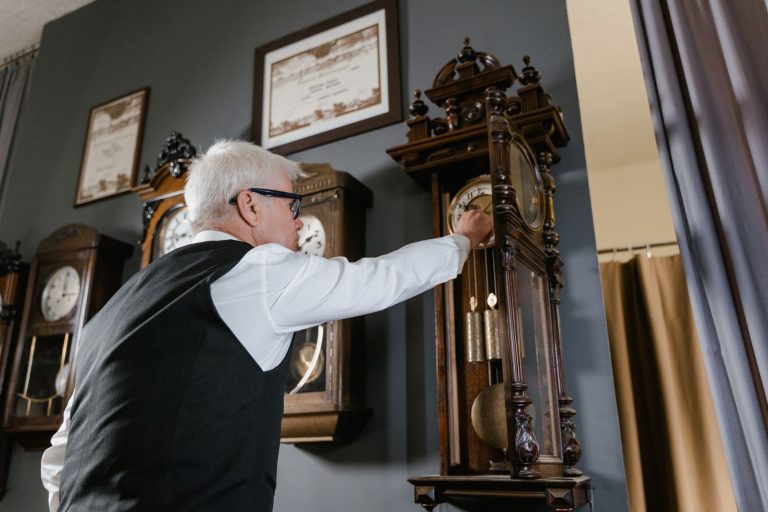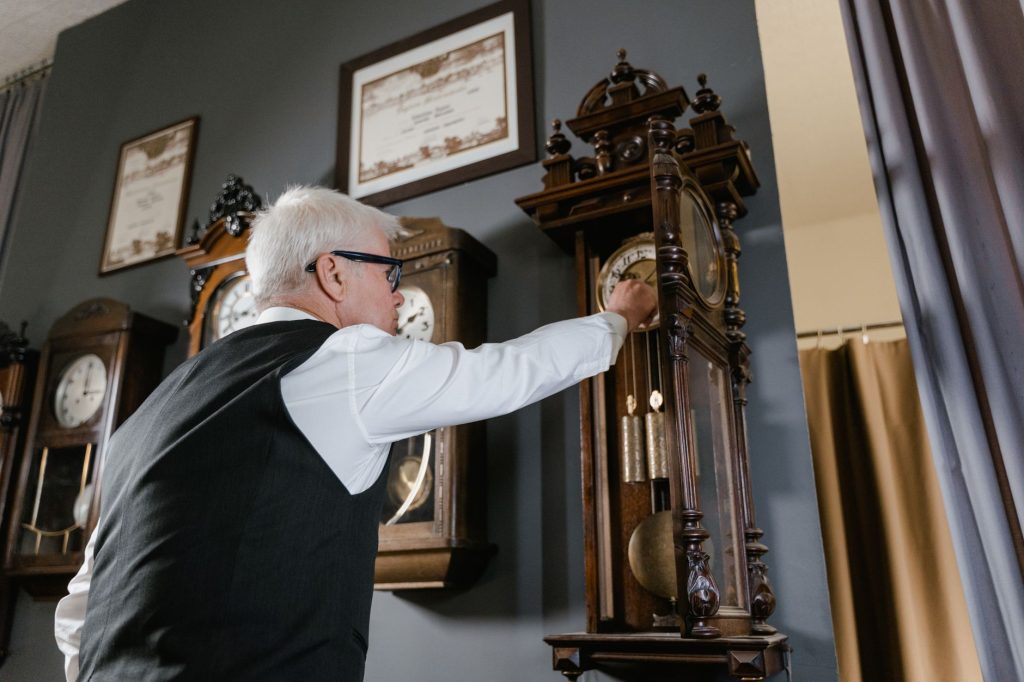
There are roughly 400 clocks running inside Mills Clock Shop at any given moment. Dave Mills knows this not because he counts them, but because he can hear when one stops.
Mills Clock Shop sits on Wilmington Pike in Kettering, in a low brick building that shares a strip with a tax preparer and a dry cleaner. From the outside there is nothing to signal what’s inside. Push open the door and the sound hits you first — a layered, overlapping tick and tock from grandfather clocks, mantel clocks, cuckoo clocks, anniversary clocks under glass domes, and a few wall-mounted regulators that Dave’s father brought in sometime in the late 1970s and never got around to selling.
Dave Mills took over from his father, Richard, in the mid-1980s. He was in his late twenties and had been working in the shop after school since he was twelve. “I didn’t decide to do this,” he said, standing behind the counter with a loupe resting against his cheekbone. “It just became obvious that this was what I did.”
What Dave does, specifically, is repair mechanical clocks. Not quartz. Not smart home devices that double as clocks. Mechanical clocks — spring-driven, weight-driven, the kind that require cleaning and oiling on a regular cycle and that, if neglected long enough, will simply seize. He estimates he’s worked on somewhere between 15,000 and 20,000 clocks in his career. He stopped keeping precise records years ago.
Most of what comes through the door is family pieces. Someone’s grandmother’s mantel clock. A grandfather clock that stopped when the house was sold and nobody thought to wind it properly at the new address. Dave takes them in, sets them on the workbench behind the counter, and diagnoses them with a patience that feels almost clinical. Repair times run a few weeks to a couple of months depending on the backlog. Costs range broadly — a standard mantel clock service might run $80 to $150, while a tall case clock can climb past $300 if it needs significant work. Dave is straightforward about this upfront.
He also sells clocks, both new and antique. Howard Miller and Hermle make up most of the new inventory. The antique cases come from estate sales and from customers who bring pieces in for repair and decide the clock isn’t worth keeping. Dave doesn’t push sales. He’ll tell you plainly if a clock isn’t worth repairing relative to its value, and he’ll tell you just as plainly if a piece you’re considering buying is overpriced somewhere else.
There are younger people in the trade, Dave says, but not many. The craft schools that trained clockmakers have mostly closed or folded their programs into broader jewelry or watchmaking curricula. He’s taken on apprentices over the years with mixed results. The work is slow and exacting and poorly compensated by the hour if you think about it too hard. “You have to like the objects,” he said. “If you don’t like the objects, you’ll quit.”
Dave likes the objects. That’s apparent within about two minutes of watching him work. He handles movements with the casual confidence of someone who has seen every variation of a problem and sorted out which matters and which doesn’t. The shop closes on Sundays and Mondays. Tuesday through Saturday, Dave is there, usually by 8:30 in the morning, the clocks ticking around him.