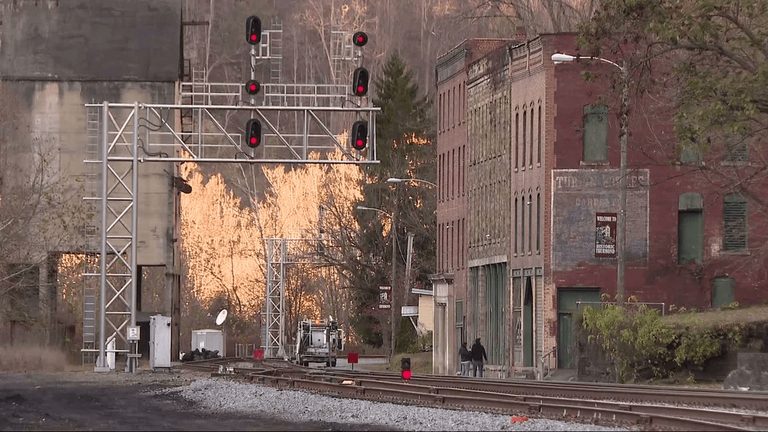
The National Park Service announced that work on a $36 million infrastructure project in Thurmond, West Virginia, will begin in early December. The effort aims to stabilize and restore historic buildings in the once‑bustling railroad town while also removing ten structures deemed unsafe or beyond repair.
Preservation group challenges demolition component
Preservation Thurmond, a nonprofit dedicated to protecting the town’s heritage, has voiced strong opposition to the demolition portion of the plan. President Holly Clark told reporters that the community “desperately wants a presence here because they love Thurmond,” and that there are viable solutions to the water‑intrusion problems cited by the agency.
“I can tell where there are water intrusion issues, and we are on a hill so there’s water intrusion, no question, but those problems are solvable,” Clark said. “There isn’t anything about these structures that cannot be fixed.”
Leasing historic buildings as a preservation strategy
The park service is already accepting proposals to lease three historic buildings within the district. Preservation Thurmond’s outreach coordinator, Jessica Flores, said offering leases could give the structures a “second lease on life.” She noted interest from local investors and community members who envision a bike shop, a coffee shop, or other small‑business uses for the vacant spaces.
“When you go to Thurmond and you visit the depot there, you don’t have anywhere to just grab a quick cup of coffee, grab a baked good,” Flores explained. “It would be really nice to get people that walk up and down Main Street to have a bottle of water, something for them to keep them around a little bit longer.”
Balancing safety, history, and economic opportunity
The National Park Service says the demolition of ten buildings is necessary to address safety hazards and to make way for infrastructure upgrades that will support increased visitor traffic to the New River Gorge area. The agency stresses that the project will preserve the historic character of Thurmond while modernizing utilities and access routes.
Local residents and business owners, however, worry that removing historic structures could erode the town’s unique identity. They argue that adaptive‑reuse projects—such as converting old warehouses into cafés or artisan workshops—could both protect the past and generate new economic activity.
Next steps and community involvement
The park service plans to hold a public meeting in early November to gather input on the lease proposals and to discuss the demolition rationale. Preservation Thurmond hopes the forum will highlight alternative preservation methods and encourage the agency to reconsider the scope of demolition.
“Let’s give them a second lease on life,” Flores urged, emphasizing that community‑driven solutions can align with the National Park Service’s goals of safety, accessibility, and heritage conservation.
As the project moves forward, Thurmond residents remain hopeful that a collaborative approach will protect the town’s historic fabric while providing the infrastructure needed for future visitors to the New River Gorge.
Original reporting: WCHS Eyewitness News Charleston (local) — read the source article.