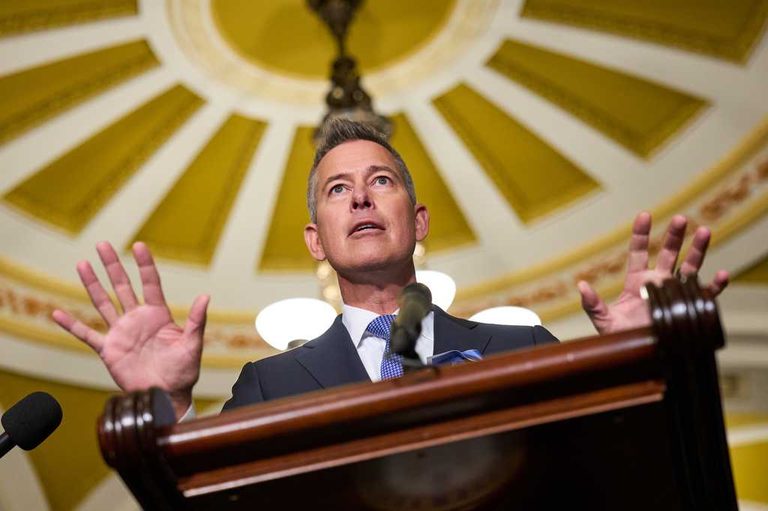
Transportation Secretary Sean Duffy said the four‑hour nationwide FAA ground stop on Friday might have been shorter had L3Harris Technologies identified a router problem more quickly. Duffy made the comments on the 2WAY streaming platform’s “The Morning Meeting” on Wednesday.
Technical glitch behind the outage
Investigators are still determining why a newly installed Juniper router at a key air‑traffic control site in Arkansas began sending thousands of connection attempts shortly after activation. The router was part of a project to replace aging copper wiring with fiber‑optic lines.
The malfunction caused the longest FAA ground stop since the September 11, 2001 attacks, lasting more than four hours. Duffy said L3Harris failed to isolate the issue promptly, contributing to the extended delay.
Agency response and next steps
FAA Administrator Bryan Bedford emphasized his personal responsibility, stating, “I am the chief accountability officer. I take full responsibility for it.” He added that the agency is pausing new installations of the same router model while technicians disable the problematic function.
Experts are testing the equipment to determine whether the router was mis‑configured by the installing technician or if the device itself was defective. L3Harris maintains the router functioned as configured.
Historical parallels and oversight concerns
The incident mirrors a 2009 outage that delayed 820 flights after a Harris technician incorrectly set up a router. Harris later merged into L3Harris, which has managed FAA network upgrades for decades. Former assistant inspector general for aviation Matthew Hampton warned that weak contractor oversight has long plagued the FAA.
Funding the modernization effort
Following the ground stop, the FAA nearly doubled its funding request to Congress, seeking $50 billion to complete the nation’s air‑traffic control modernization. Only about $10 billion would fund new air‑traffic control technology; the remainder would support runway upgrades, tower improvements, and replacement of aging control centers.
Lawmakers expressed skepticism about approving the full amount, noting the agency has not yet spent all funds appropriated last year. Duffy explained that many of the new radars and systems are still in production, limiting immediate purchases.
Industry reaction
Chris Sununu, president of the Airlines for America trade group, praised Bedford’s communication during the crisis, noting the FAA held multiple conference calls with airline CEOs and operations leaders throughout the outage.
Sununu said the FAA’s task of overhauling “the most robust telecom system on the planet while using it 24 hours a day” is inherently complex, and further technical hiccups are likely as multigenerational technologies are integrated.
What’s next?
The FAA continues its investigation, focusing on whether the router’s configuration or a hardware fault caused the outage. In the meantime, the agency has halted further installations of the affected router model and is working to strengthen contractor oversight to prevent future disruptions.
Original reporting: WPBF (Treasure Coast / Hearst) — read the source article.