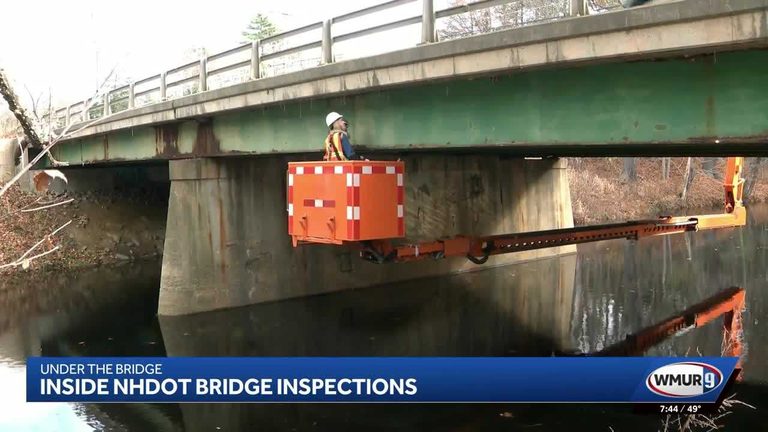
New Hampshire’s Department of Transportation (NHDOT) is stepping up its bridge‑inspection program after a series of closures earlier this year. With more than 3,800 state and municipal bridges under its watch, the agency is confronting an aging inventory that the American Society of Civil Engineers rates at a C‑minus overall.
Statewide bridge condition overview
According to the 2025 annual bridge report, the average New Hampshire bridge is over 65 years old, and 55% were built before 1960—well beyond the typical 50‑80‑year design life. Michael Mozer, the state bridge engineer and administrator for NHDOT, acknowledges the challenge: “I think a C‑minus is pretty much in line with where we see ourselves. We have an aging bridge inventory, so we’re looking at ways to maintain those.”
Inspection process and grading system
Bill Saffian, chief of the Existing Bridge Section, explains that inspectors focus on two key questions: the severity of any problem and its extent. They categorize issues as minor, moderate or severe, then assign each bridge a numeric rating from zero (closed) to nine (excellent). A rating of four marks the start of “poor” condition.
When a potential problem is found, safety takes precedence. “If we find a problem that needs further investigation, out of an abundance of caution we have to close the bridge,” Saffian said. “We can’t risk a delay that might lead to something very bad happening.” The recent closure of the Queen City Bridge illustrated this approach; a crack in the paint was discovered, not a structural failure, and the bridge was promptly reopened after verification.
Red List bridges receive extra attention
Bridges that score four or lower on any component—deck, superstructure or substructure—are placed on the agency’s Red List. Those structures are inspected twice a year. One such bridge, identified as Bridge No. 225/139 on Route 125 in Rochester, was examined with News 9 reporters. The Rochester bridge, now rated “poor” across all components, shows classic signs of New Hampshire’s harsh winters: chloride stalactites, rusted beams and efflorescence from deck cracks.
“From day one we are fighting Mother Nature,” Saffian noted. “De‑icing salts, freeze‑thaw cycles and the natural aging of materials all contribute to deterioration.” The Rochester bridge is one of 127 bridges currently on the Red List, down from 151 in 2016, indicating progress through rehabilitation and replacement projects.
Safety remains the priority
Officials stress that a lower rating does not automatically mean a bridge is unsafe for travel; it simply signals the need for closer monitoring and maintenance. “A lower‑grade bridge does not necessarily mean that the bridge is unsafe. It just means we want to be more focused on the problems,” Saffian said.
Mozer added that the ultimate goal is to ensure residents can travel without worry: “We want to make sure the bridge can continue to maintain this through its life cycle, and we also want to maintain the safety of the traveling public at all times.”
Looking ahead
The NHDOT continues to evaluate long‑term solutions, including targeted rehabilitation and full replacements where needed. Recent successes, such as the replacement of the Neil R. Underwood Memorial Bridge (now the Hampton River Bridge), demonstrate that proactive investment can move bridges off the Red List and extend their service life.
As New Hampshire’s bridge network ages, the department’s transparent inspection process and commitment to safety aim to keep the state’s transportation arteries reliable for families, businesses and commuters alike.
Original reporting: WMUR (Hearst) – local news — read the source article.