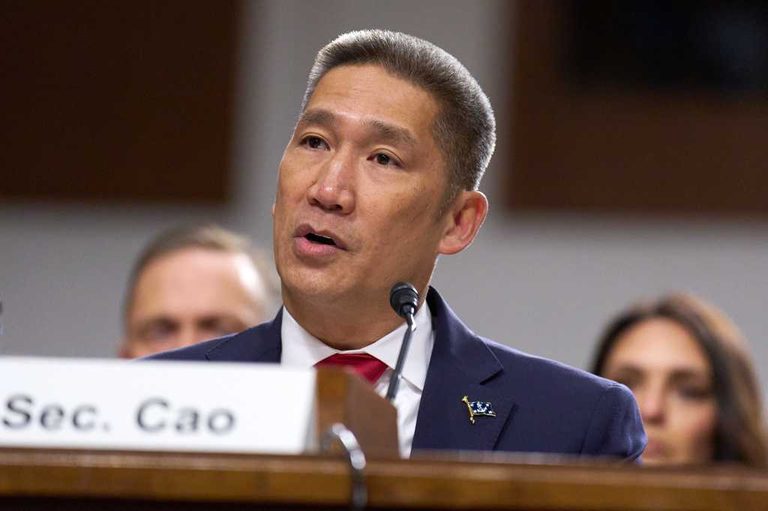
President Donald Trump’s nominee for the top civilian post at the U.S. Navy, Acting Secretary Hung Cao, faced a bipartisan Senate hearing on Tuesday. Cao, a combat veteran and longtime Trump supporter, acknowledged that the conflict with Iran is placing a heavy burden on the service’s ships, munitions and sailors.
Senate grilling focuses on costs and sailor welfare
Senators from both parties pressed Cao on the financial and human toll of the Iran war. Democratic Sen. Elizabeth Warren cited estimates that the naval blockade of Iranian shipping costs roughly $32.5 million per day and that Iranian strikes on the Navy’s regional headquarters in Bahrain have caused at least $400 million in damage. Cao confirmed the blockade figure but said a full damage assessment in Bahrain was not possible because the area is “non‑permissive” for U.S. forces.
Lawmakers also raised concerns about living conditions aboard deployed warships. Reports of crew stress, supply shortages and even severe weight loss among sailors were highlighted. Republican Sen. Roger Wicker, chair of the Armed Services Committee, noted that “incredibly challenging deployments” take a toll on sailors and their families. Democratic Sen. Mark Kelly shared a parent’s account of a child losing more than 45 pounds in six months due to limited food on a ship.
When asked about hunger on board, Cao likened it to “my kids opening the refrigerator door and saying there’s nothing to eat in here.” He also described eight suicide attempts as “eight suicide mitigations,” emphasizing the Navy’s efforts to intervene.
Munition shortages and production boosts
The Iran conflict has strained U.S. stockpiles of air‑defense interceptors and Tomahawk cruise missiles. GOP Sen. Deb Fischer and Sen. Joni Ernst warned that dwindling munitions could hamper future operations. Cao responded that production of Tomahawks has increased dramatically, saying the Navy now produces “well above 60 every month” compared with only 125 per year when he was in uniform.
He also noted steps to accelerate interceptor manufacturing. However, Cao admitted the Navy has resorted to using some expired munitions, comparing the process to “adding water to expired bread and putting it in the microwave.” He did not specify which weapons were involved.
Leadership changes and civilian‑control concerns
Democratic members questioned the Navy’s handling of recent command removals, including the firing of a nuclear‑powered attack submarine’s leadership team after an underwater collision. Cao defended the practice, saying the goal is to protect the careers of officers after disciplinary actions.
Cao’s confirmation is complicated by a statutory waiver requirement. Because he left active duty in 2021, he must obtain a congressional waiver that allows former military officers to serve as a service secretary without the usual seven‑year retirement gap. Such waivers have been granted only three times in history, most recently for retired Gen. James Mattis under President Trump and retired Gen. Lloyd Austin under President Biden.
Political backdrop
The hearing comes as Republicans have lost control of both the House and Senate in the recent midterm elections, a result many view as a repudiation of the Iran war. Democrats will assume control of Congress in January, setting the stage for heightened scrutiny of the Trump administration’s foreign‑policy decisions.
Despite the challenges, Cao emphasized that the Iran conflict is “really set China back on their heels,” arguing that the joint effort of all military services demonstrates U.S. resolve.
Original reporting: Oklahoma City News Feed (HLL/CB) — read the source article.