In a move that aligns with President Donald Trump’s executive order to create a federal Space Academy, Nevada is officially in the running to host the facility. A coalition headed by Selene Industries and the Governor’s Office of Economic Development filed a detailed proposal with the federal government, outlining why the Silver State is uniquely qualified.
Why Nevada?
The coalition’s release emphasizes Nevada’s existing aerospace infrastructure. “Nellis Air Force Base, the Nevada Test and Training Range, Naval Air Station Fallon, and the Nevada National Security Site, where Apollo astronauts once trained, place cadets within reach of the nation’s premier flight, test and training environments,” the statement reads.
Since 2016, Nevada’s aerospace workforce has grown 56%, now representing roughly 22,300 jobs. The state also points out that no federal service academy currently sits west of the Rocky Mountains, making the location strategically valuable for future lunar and Martian missions.
Campus vision
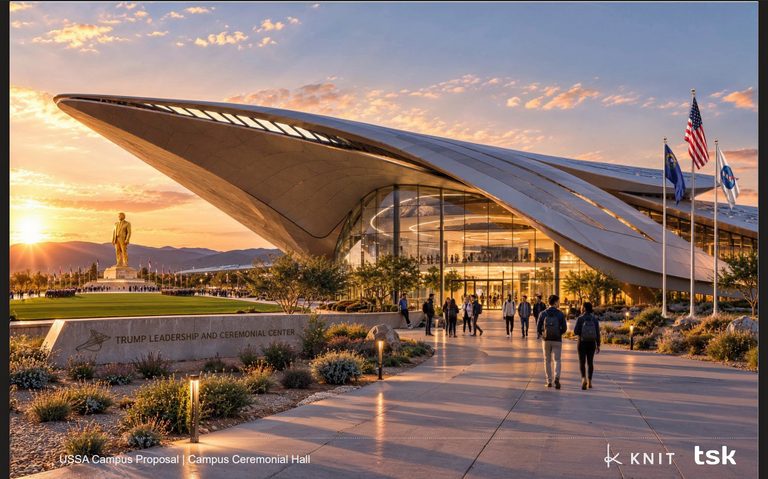
The proposed campus would occupy up to 45,000 acres along Interstate 80 east of Reno, with an 8,300‑acre core site in Lyon County for academic buildings and an additional launch and test complex in Churchill County. Four alternate sites in southern Nevada—including North Las Vegas, Mesquite, Laughlin, and an area northeast of Nellis—also meet NASA’s 300‑acre minimum.
Design partners Knit and TSK Architects envision a self‑sufficient model that generates its own power and recycles every drop of water, mirroring the conditions cadets will face on the Moon or Mars. The plan calls for construction to begin in 2027, an inaugural class in 2028, and a permanent campus operating by 2031, eventually serving up to 4,000 students.
Economic and legislative support
Congresswoman Susie Lee, Nevada’s federal delegation leader, praised the bid, noting the state’s “existing federal test and training infrastructure and active NASA lunar training capabilities” as well as its strong aerospace and defense workforce pipelines.
If the presidential commission selects Nevada, state lawmakers intend to introduce legislation in 2027 to allocate up to $300 million toward the project. In the interim, Nevada’s higher‑education institutions and the Desert Research Institute would host the first class in existing facilities while the permanent campus is built.
Partners and cost estimate
The proposal lists a broad coalition of partners, including Mark IV Capital, Sol‑Up, Valkyrie Systems Aerospace, Ecoatoms, CBRE, PURE America, and Siemens Digital Industries, covering land, energy, finance, and technical training. The Whiting‑Turner Contracting Company prepared a construction cost estimate, though the exact figure was not disclosed.
Overall, the Nevada bid presents a compelling case that blends existing military‑grade training sites, a rapidly expanding aerospace labor pool, and a vision for a self‑sustaining educational campus that prepares America’s next generation of space leaders.
Original reporting: KTNV 13 Action News Las Vegas (local) — read the source article.