Illinois is enjoying a modest fiscal cushion this year, but state officials warn that a steep deficit looms once new federal policies take hold. The Governor’s Office of Management and Budget (GOMB) says the state will post a $927 million surplus for fiscal year 2027, which ends June 30, 2027.
Governor Pritzker’s cautious budgeting
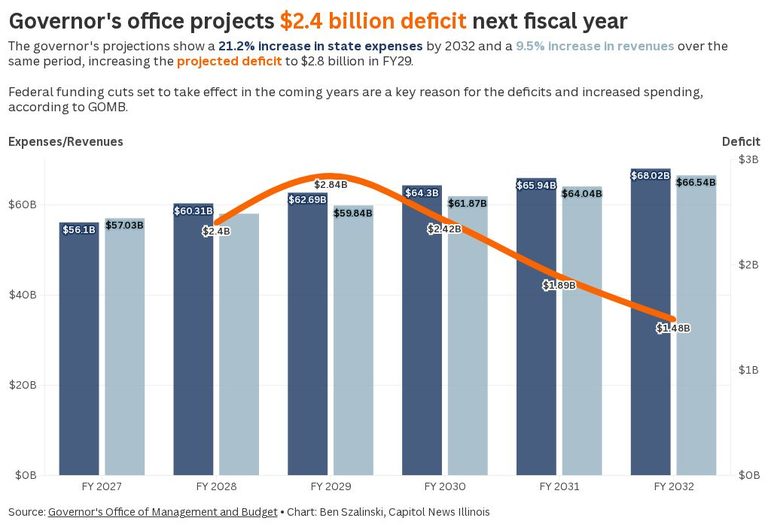
Governor JB Pritzker plans to set aside much of that surplus to brace for a projected $2.4 billion deficit in FY 2028. The governor’s office is drafting a supplemental spending plan that would allocate $728 million to address upcoming costs, leaving a $199 million surplus at the close of FY 2027.
The shortfall stems largely from federal policy shifts enacted by the Trump administration, including expanded Medicaid and Supplemental Nutrition Assistance Program (SNAP) obligations that will shift from federal to state responsibility. Federal law beginning July 1, 2027 will also require managed‑care organizations to pay the same tax rate as non‑Medicaid affiliates, creating a $1.3 billion gap in Illinois’ budget if current tax levels remain unchanged.
Revenue and spending outlook
GOMB’s five‑year projection, based on S&P Global’s September forecast, expects Illinois to collect about $58 billion in revenue next year—roughly $1 billion more than the current year, driven by personal income‑tax growth. However, projected spending will rise to $60.3 billion, up from $56 billion this year, as the state prepares to cover roughly $1.4 billion in costs previously funded by the federal government.
Additional federal changes will further strain the budget. A gradual reduction in the hospital provider tax—from a maximum of 6 % to 3.5 % by FY 2032—will diminish federal matching funds for Medicaid, cutting state Medicaid support by about $2.8 billion by FY 2032. Illinois will also assume a larger share of SNAP benefits beginning FY 2029, an expense that could exceed $400 million annually.
Legislative and community response
State lawmakers will need to close the projected deficit to meet the constitutional requirement for a balanced budget. The Illinois Federation of Teachers plans to lobby for an additional $400 million in Evidence‑Based Funding for public schools, on top of the $350 million increase already approved. Chicago Public Schools are also seeking $150 million in new state funding for the current school year.
The University of Illinois Board of Trustees has asked for a 10.9 % boost to its FY 2028 budget—about $80.5 million—citing the need to prepare students for advances in artificial intelligence and quantum computing. The university also seeks $88.5 million for UI Health to offset Medicaid cuts.
Balancing priorities
Governor Pritzker has historically limited new spending to statutory increases for pensions and education, preferring targeted tax measures over broad tax hikes. With the Trump administration’s federal reforms limiting the state’s ability to replace lost funding, officials warn that large new spending initiatives are unlikely.
“Canceled and reduced grants to entities in Illinois total several hundred million dollars, with significantly more potential cuts currently subject to litigation,” the GOMB report states. The report underscores the state’s limited capacity to replace lost federal grants for specialized programs and local governments.
As Illinois navigates these fiscal headwinds, the governor’s office emphasizes prudence, urging lawmakers to prioritize essential services while seeking efficient ways to fund education, health care and disaster relief without overburdening taxpayers.
Original reporting: Capitol City Now (WTAX 1240 Springfield) — read the source article.