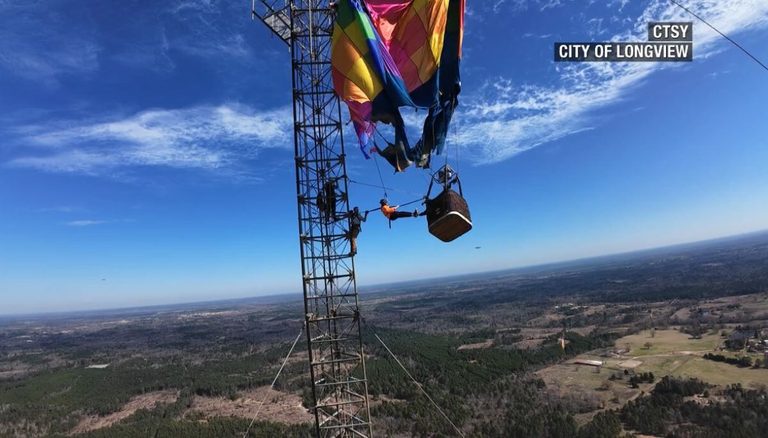
Gregg County – The National Transportation Safety Board (NTSB) released its final investigation of the hot‑air balloon accident that occurred on February 28 in East Mountain. The board determined that the pilot’s failure to maintain proper clearance while attempting to land in changing wind conditions caused the balloon to become entangled in the guy wire of a nearby radio tower.
What the investigation revealed
According to the NTSB report, the pilot reported surface winds of roughly 7 to 10 miles per hour at takeoff from Longview. After launch, the balloon traveled north‑northwest toward an open field adjacent to a high school, the intended landing site. However, the balloon overshot the field as winds increased to 600‑900 feet above ground and shifted direction, pushing the craft toward a radio tower.
Facing no suitable landing area before reaching the tower, the pilot fired the balloon’s propane burner to climb higher. The balloon then became caught in a guy wire attached to the tower’s structure. The investigation noted that the balloon’s envelope was severely torn and the basket suffered substantial damage, but no mechanical failures were reported prior to the incident.
Rescue operation
Longview firefighters responded quickly to the emergency. Using specialized equipment, they rescued both the pilot and the passenger, who were trapped more than 900 feet in the air. Both individuals emerged from the incident without injuries.
Pilot experience
The NTSB report lists the pilot’s total flight time at 464 hours across all aircraft, with 72 hours logged in a balloon of the same make and model. Notably, the pilot had not flown in the 90 days preceding the crash, a factor the board highlighted in its analysis.
Agency involvement
The NTSB clarified that it did not travel to the crash site for its investigation, relying instead on data provided by the pilot, local authorities, and other sources.
Community response
Local residents expressed gratitude for the swift actions of Longview’s fire department. The incident underscores the importance of vigilant pilot training and the challenges that variable wind conditions can pose to lighter‑than‑air aviation.
Authorities continue to emphasize safety measures for balloon operators, especially when operating near structures such as radio towers. The NTSB’s findings will be used to inform future guidelines and training programs aimed at preventing similar accidents.
Original reporting: KLTV 7 Tyler (news) — read the source article.