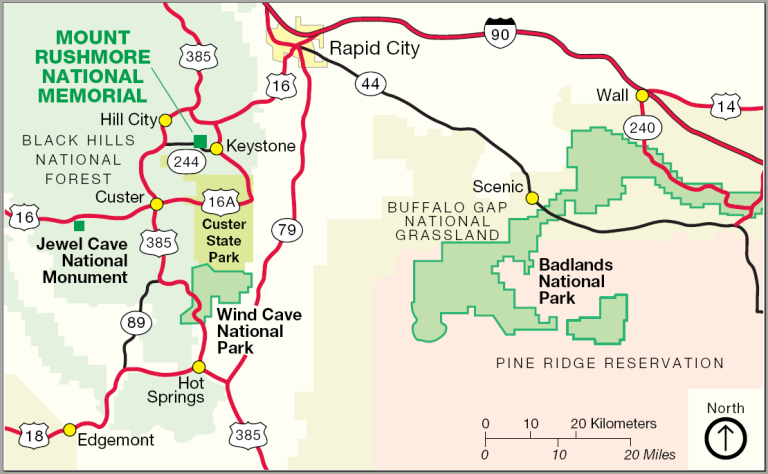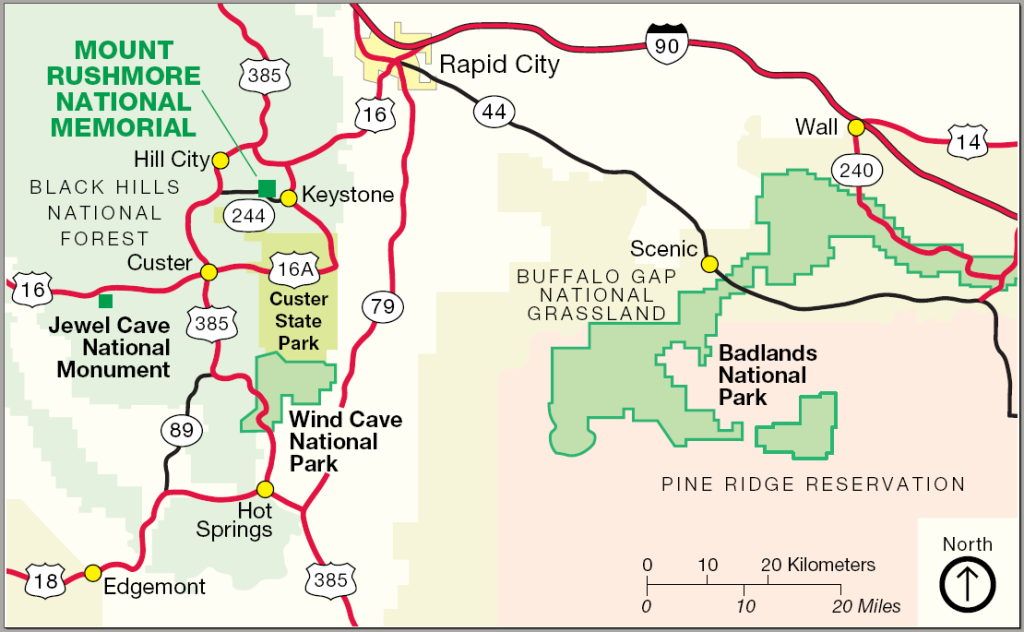
It was about eleven in the morning on a Thursday in June when I pulled off Highway 40 outside Keystone, maybe twenty minutes from downtown Rapid City, and followed the signs up a narrow switchback to the entrance of Rushmore Cave. I’d driven past the signs a dozen times over the years and always kept going. That was a mistake I won’t repeat.
The cave sits inside a limestone ridge in the Black Hills, and it’s been open to the public since 1927. That’s not a selling point I would have cared about before I went in. After the tour, it makes a lot more sense. The place has accumulated a certain lived-in character that you don’t manufacture with new paint and LED uplighting.
Tours run on a set schedule and last about an hour. I bought my ticket at the small visitor center at the top of the hill — adults run around $20, kids a bit less — and waited maybe ten minutes before our group of eight or nine people headed in through a low concrete entrance. The guide, a college-age guy who clearly knew the formations by name the way a person knows their neighborhood, led us down into the main passage almost immediately.
What hits you first is the temperature. It’s a steady 53 degrees in there regardless of what’s happening outside, which in June felt almost comically good. The humidity is high, so there’s a faint mineral smell to the air, not unpleasant, more like old stone and water. Bring a layer. I did not, and I borrowed a sweatshirt from the gift shop pile near the entrance, which I later had to return with some embarrassment.
The cave itself runs maybe a third of a mile in length on the standard tour. The passages vary — some wide enough to walk comfortably, a couple low enough that I had to watch my head on the ceiling. The formations are the draw: stalactites and stalagmites in the usual sense, but also helictites, which are the twisting, gravity-defying ones that grow sideways or in spirals. The guide pointed them out carefully and explained how they form, something about capillary forces in the mineral water. I retained about half of it, but I was looking at them the whole time.
There’s a room partway through that the guide calls the Ballroom, a wider chamber where the ceiling opens up and the formations cluster densely overhead. The lighting down there is subtle, mostly white and yellow, and it does something strange to your sense of scale. You forget for a moment that you’re under a mountain in South Dakota.
No photography restrictions that I noticed, so I took a lot of pictures. Most of them came out poorly because cave lighting is hard, but that’s a me problem.
The whole experience is low-key in the best way. It’s not trying to compete with Wind Cave or Jewel Cave on spectacle or size. It’s a family operation — been in the same hands for generations — and that shows in the approach: straightforward, unhurried, and genuinely informative without being scripted to death.
I was back at my car by half past noon. If you’re running a day out from Rapid City toward Keystone anyway, stopping here adds an hour and costs less than lunch. I’d argue it’s the more memorable part of that drive, which is saying something given the scenery on Highway 40.