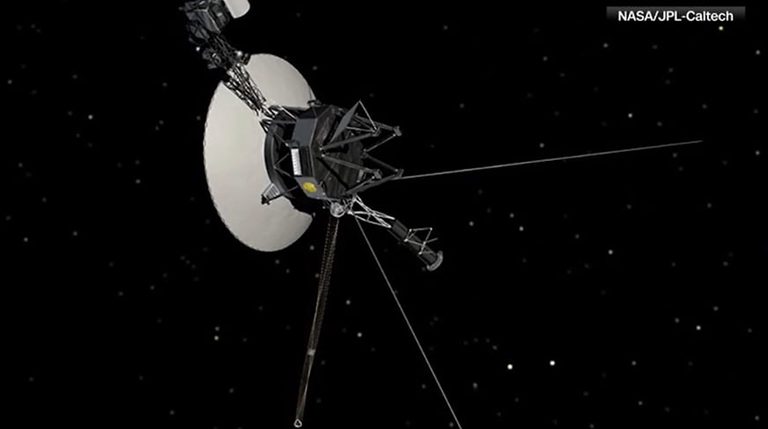
NASA announced that Voyager 1 will reach a distance of one light‑day from Earth early Wednesday, marking the first time a human‑made object has traveled that far. The spacecraft, launched in 1977, will be about 16 billion miles away at 4:16:07 a.m. Central Time.
Kansas Cosmosphere’s historic connection
The milestone also shines a spotlight on Kansas’s own contribution to the mission. The Cosmosphere in Hutchinson, originally called the Kansas Cosmosphere, broke ground in 1977 and expanded in 1992. According to the museum, radio signals from Voyager 1 were used to set off explosives that cleared the land for the original construction site, linking the state’s premier space museum directly to the probe’s early days.
Scientific achievements celebrated locally
Wichita State University physics professor Dr. Jason Ferguson explained why Voyager 1 remains a source of pride for scientists and Kansas residents alike. Over its decades in space, the probe sent back iconic images of Jupiter and Saturn, confirmed the number of Jupiter’s moons, and captured the famous “pale blue dot” photograph of Earth from the outer solar system.
“That image reminds us how vast the universe is and how small our planet is in comparison,” Dr. Ferguson said. He added that while many of Voyager’s instruments, including its cameras, have been turned off, a few still record data on the density and temperature of interstellar space, a region the probe entered in 2012.
What a light‑day means
A “light‑day” is the distance light travels in 24 hours—roughly 16 billion miles. Reaching this distance is a historic first for any spacecraft, underscoring the durability of the engineering that launched Voyager 1 more than half a century ago.
Local pride in a global achievement
For Kansans, the Cosmosphere’s involvement offers a tangible link to a mission that has captured the imagination of people worldwide. The museum continues to feature Voyager‑related exhibits, allowing visitors to learn about the probe’s journey and the state’s role in space exploration.
As Voyager 1 sails toward a star more than 17 light‑years away, its legacy endures both in the scientific community and in the hearts of Kansas residents who helped launch it into the cosmos.
Original reporting: KWCH 12 (Gray) – local — read the source article.