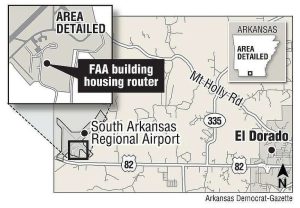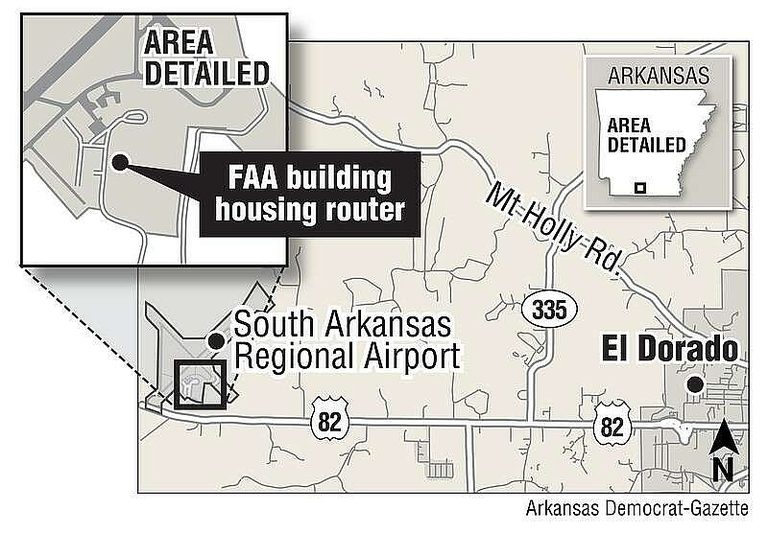
Early Sunday morning, El Dorado Mayor Paul Choate was watching ABC News when the story broke about a nearly five‑hour nationwide air‑traffic ground stop that forced about 3,500 flights to land and caused thousands of cancellations. The FAA said the incident stemmed from technical glitches with industrial routers at two of its radar facilities—one in Amarillo, Texas, and the other at the South Arkansas Regional Airport at Goodwin Field in El Dorado.
Local reaction and clarification
Choate, who recently lost his bid for re‑election, said the airport’s manager reported no activity that could have caused the outage. He also took issue with media references that mispronounced the city’s name and labeled El Dorado as “the middle of nowhere.” “El‑Duh‑Ray‑Duh is the proper pronunciation for us folks here in South Arkansas,” Choate said, noting a recent Chamber of Commerce Facebook post that offered the same guidance.
Despite the criticism, Choate dismissed the negative remarks, adding, “Go ahead and use the Yankee quote. I lost my election. I’m not coming back Jan. 1.” He also expressed confidence in his community, stating, “I believe we’re the center of the universe from where I sit.”
Expert disagreement on the cause
Aviation experts remain divided. Michael McCormick, a professor at Embry‑Riddle Aeronautical University, supports the FAA’s explanation that a faulty router overwhelmed legacy telecommunications infrastructure (FTI). He explained that the FAA’s network relies on redundant routers that normally reroute data when one fails. In this case, the routers received thousands of connection attempts every few seconds, overwhelming the older T1 copper lines.
Conversely, airline analyst Robert Mann Jr. told the New York Times that the FAA’s description is “not plausible” because the network is designed to be fully redundant. Mann suggests the newer $875 million SMART AI system, rolled out just days before the incident, may have been the trigger. The SMART system centralizes 200 data streams—including weather, flight paths, and controller staffing—into a single platform located near Washington, D.C.
The FAA has denied any link between the ground stop and the SMART system. Transportation Secretary Sean Duffy and FAA Administrator Bryan Bedford introduced SMART in September, describing it as a “cutting‑edge tool” for predicting and mitigating air‑traffic problems. During its initial test in the Washington area this fall, the system reportedly rerouted 180 flights, saving an average of ten minutes and 80 gallons of fuel per flight.
Mayor’s perspective and community response
Choate received a text from Russellville Mayor Fred Teague while attending church, asking what he had done to shut down national air traffic. Choate replied, “Absolutely nothing. It’s not our fault,” and added, “Well, you’re going to get blamed for it anyway. You’re the mayor.” He acknowledged that the exact cause may never be fully known, but noted the significance of a small town being thrust into a national spotlight.
“What amazes me is something that can happen in the middle of nowhere can have such a devastating effect to the entire nation,” Choate said.
What’s next?
The FAA continues its investigation, and both technical and AI‑related explanations remain on the table. Local officials are urging the agency to provide clear communication to avoid future misunderstandings that could unfairly tarnish El Dorado’s reputation.
Original reporting: Texarkana Gazette — read the source article.