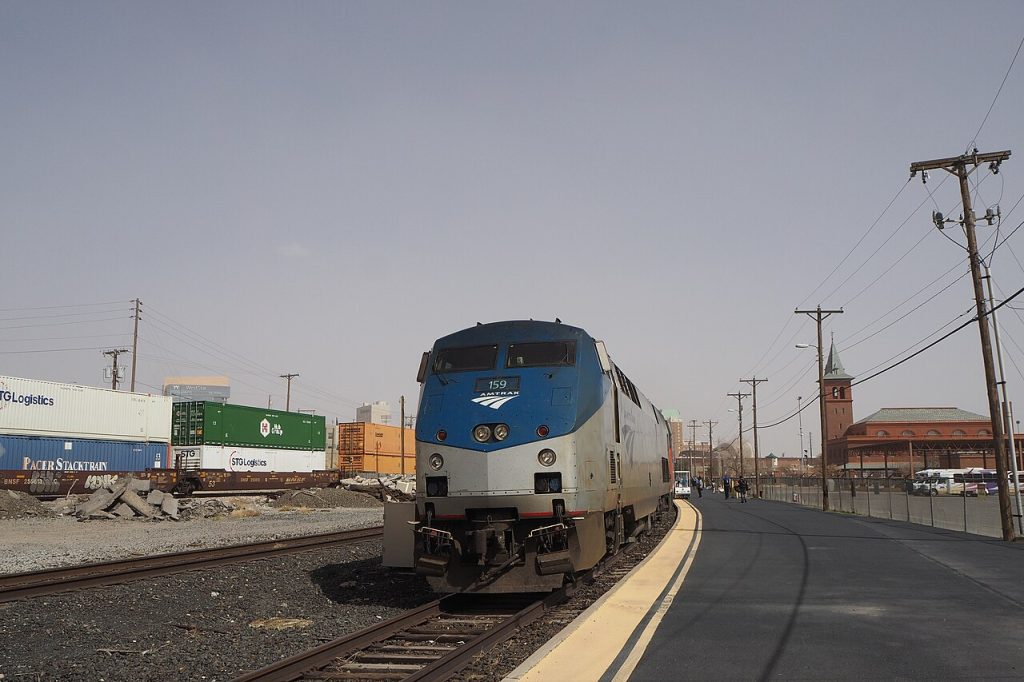
The Union Depot at the corner of San Francisco Avenue and Santa Fe Street has been standing since 1906, and on most weekday mornings it carries that specific quiet of a building that has outlasted several of its own purposes. The Beaux-Arts facade, with its arched windows and terracotta trim, faces south toward the border crossing and north toward downtown with equal indifference. It doesn’t perform its history; it just sits with it.
El Paso was, for decades, one of the busiest rail crossroads on the continent. Southern Pacific, the Texas and Pacific, the Santa Fe, and several Mexican lines all passed through this terminal. At its peak in the 1940s, the depot handled troop movements during World War II alongside ordinary passenger traffic — tens of thousands of soldiers passing through on their way to assignments in California, the Pacific, or points east. The waiting room floors absorbed a lot of uncertain goodbyes.
Amtrak still uses the station, which is a fact worth sitting with. The Sunset Limited runs three days a week in each direction — Los Angeles to New Orleans and back — and the Texas Eagle connects up through San Antonio to Chicago. The trains don’t come through at convenient hours; westbound on the Sunset Limited typically arrives somewhere around midnight, eastbound not long after dawn. That inconvenience is, in a strange way, part of the experience. The platform at three in the morning, with the lights of Juárez visible across the river and a locomotive idling, is one of the more atmospheric places in the city.
The main waiting room has been partially restored and retains its original terrazzo floors and high ceilings. It’s not a museum — people actually wait here for trains — but the architecture alone justifies a visit even without a ticket. The building was added to the National Register of Historic Places in 1980, though the acknowledgment has never translated into the kind of full restoration the structure probably deserves. Some corners show their age more than others.
Adjacent to the depot, the rail yard and surrounding Union Plaza district have seen incremental redevelopment over the past decade, with bars, art spaces, and event venues filling some of the older warehouse buildings nearby. The depot itself sits at the edge of this activity, never quite absorbed into it. That distance feels appropriate.
Getting there is straightforward — it’s about six blocks south of San Jacinto Plaza, with street parking available along Santa Fe Street. If the goal is simply to look at the building and walk the platform, there’s no charge. For anyone actually boarding a train, Amtrak fares vary considerably depending on the route and how far in advance tickets are purchased; a one-way to Tucson typically runs $30 to $70. The station has no cafe, so arrive fed.
What stays with most people who visit is the scale of the waiting room and the specific weight of a building that has been consequential. El Paso’s history as a border city, a rail hub, a military staging ground, and a crossing point for generations of migrants is compressed into this one structure. It’s worth an hour on a slow afternoon.