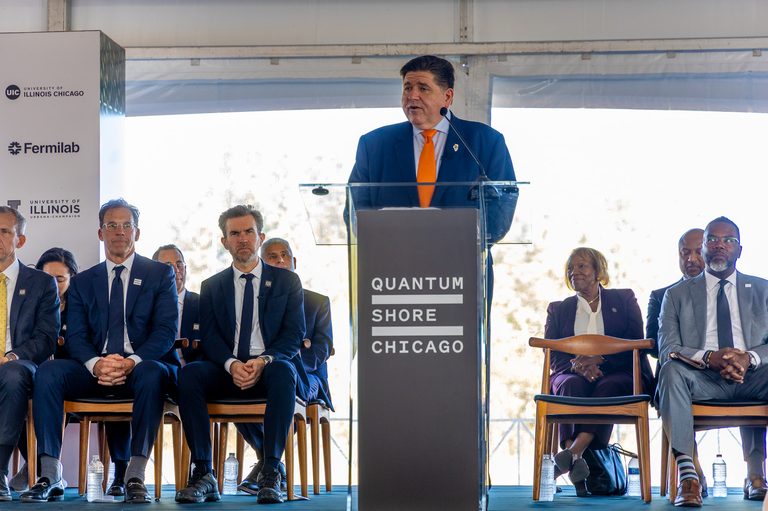
South Chicago residents made their voices heard in this month’s election, voting overwhelmingly against a proposal to allocate roughly $1 billion of taxpayer money to the Quantum Shore Chicago megadevelopment on the former South Works site. The ballot question asked whether Illinois governmental bodies should spend the estimated funds to support a quantum computing facility and data center.
According to the Chicago Board of Elections, 78% of the 1,059 voters who cast ballots in one 7th Ward precinct and two 10th Ward precincts answered “no.” The same voters also approved, by 88% of 1,050 participants, a non‑binding measure urging state and local officials to ensure a “complete and transparent” remediation of the former steel plant.
Funding and Development Details
Developers Related Midwest and CRG are transforming the former U.S. Steel South Works site into Quantum Shore Chicago, a multi‑billion‑dollar project anchored by the Illinois Quantum and Microelectronics Park. Governor J.B. Pritzker has earmarked $500 million for the quantum campus and $200 million for the Chicago Quantum Exchange. The state’s Department of Commerce and Economic Opportunity contributed $99 million for cryogenic infrastructure, while the Cook County Board approved a $20 million grant for a cryogenic facility supporting PsiQuantum’s operations.
Tech giant IBM has pledged to create 750 jobs in exchange for an estimated $19 million in state tax credits to build a computing hub on the campus. The City of Chicago is adding $5 million from its housing and economic development bond, and the project is slated to receive about $175 million in county property‑tax breaks over 30 years.
Cleanup Plans and Community Concerns
The developers’ remediation plan, approved by the Illinois Environmental Protection Agency last year, includes a barrier system designed to prevent pollutants from reaching Lake Michigan or the Calumet River. Work to date has involved constructing nearly two miles of slurry walls to contain petroleum‑contaminated soil and a horizontal barrier to lock in heavy metals such as arsenic, chromium and manganese.
Developers say the plan follows proven methods, prioritizes human health, and meets current regulatory standards. Dust monitors and mitigation measures are intended to control dust, noise, and vibration during cleanup. State‑submitted test results indicated that heavy metals are unlikely to migrate and do not exceed hazardous‑waste toxicity thresholds.
Nevertheless, some residents remain uneasy about potential exposure to slag, contaminated soil, and other byproducts of the former steel‑making process. Science for the People Chicago, a group of University of Chicago researchers and students, criticized the dust‑mitigation strategy and raised concerns about lakefront flooding risks.
Local Political Response
Activists from Southside Together, the organization that placed the ballot questions, highlighted the vote as validation of their campaign. “Nobody asked me my opinion before they started this construction,” said Stephanie Williams, a homeowner in the 7th Ward precinct. “This is my neighborhood and you will not poison it.”
Other community members praised the project’s potential to revitalize a long‑vacant site and attract new investment. Some residents are calling for a binding community‑benefits agreement to lock in promised local advantages.
Aldermen Greg Mitchell (7th Ward) and Peter Chico (10th Ward), both seeking reelection in February, have publicly supported the development but did not respond to interview requests for comment.
What Comes Next
The ballot results send a clear message to state and local officials: while the community welcomes a thorough cleanup, it is skeptical of large‑scale public spending on a high‑tech megaproject without stronger assurances of local benefit. The developers must now address resident concerns and consider formal community‑benefits commitments as they move forward with the Quantum Shore plan.
Original reporting: Block Club Chicago — read the source article.