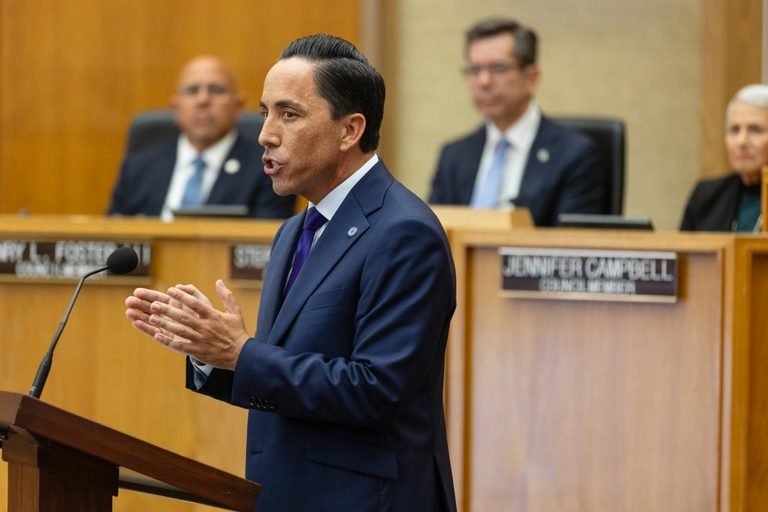
San Diego – In a decisive statement to the City Council, Mayor Todd Gloria confirmed he will not veto a vote to cancel the city’s contract with surveillance technology company Flock. The mayor said the system, once praised as a crime‑fighting tool, has “clearly lost public trust” and must be justified by tangible public‑safety value and strong accountability.
Council Shift Brings Cancellation Within Reach
Recent weeks have seen a realignment on the council regarding the Flock contract. Councilmember Stephen Whitburn announced last month that he now supports cancelling the agreement, tipping the balance toward a majority in favor of termination. The move set the stage for the council’s first step toward dismantling the sprawling network of automated license‑plate readers.
However, the effort faced a potential veto hurdle: overturning a mayoral veto would require six council votes, and the opposition held five. The dynamic changed again last week when Councilmember Raul Campillo switched sides, citing concerns that the San Diego Police Department had used Flock to surveil its own officers and, in one troubling instance, a domestic‑violence survivor.
Mayor’s Rationale Emphasizes Fiscal Responsibility and Trust
Mayor Gloria’s statement underscored the importance of every taxpayer dollar. “At a time when each taxpayer dollar matters, every city investment has to justify itself. That means delivering public safety value, operating with strong accountability and maintaining the trust of the people who are paying for it,” he said.
While acknowledging Flock’s past contributions to crime fighting, Gloria stressed that the technology must earn continued public confidence and demonstrate cost‑effectiveness. His pledge not to veto the council’s cancellation vote removes a major obstacle, leaving the outcome to the council’s six‑vote threshold.
Parallel Debate Over Municipal Power
In related council business, the Environment Committee approved a resolution affirming San Diego’s ambition to pursue a publicly‑run energy grid. Councilmembers Joe LaCava and Sean Elo‑Rivera voted for the measure, while Councilmember Jen Campbell opposed it, warning that the city could not afford a multi‑billion‑dollar grid amid a budget deficit.
Elo‑Rivera countered that removing one billion dollars in profit and tens of millions in executive compensation could make the plan viable for San Diegans. He argued, “When you remove one billion dollars in profit and tens of millions in executive pay, it becomes easy to see how the formula could work for San Diegans.”
Labor opposition remains strong. Nate Fairman, business manager of the International Brotherhood of Electrical Workers Local 465, said, “We stand firmly against any efforts to municipalize San Diego Gas and Electric. We don’t trust the city government to take over the utility grid.”
Public Power San Diego program director Isaiah Glasoe clarified that a public‑power agency would operate independently of the city, overseen by a board of technical experts, public members, and labor representatives. “The option is to have a billion dollars in wealth leaving San Diego or invested in San Diego,” he said.
Next Steps
The council will vote on the Flock contract cancellation at its Monday meeting. With Mayor Gloria’s assurance that he will not veto, the council needs only one additional vote to achieve the six‑vote majority required to overturn a veto, should one arise.
Following the council’s decision on the surveillance contract, the public‑power resolution will move to the full City Council for a final vote.
Community Reaction
Local residents and advocacy groups have expressed mixed feelings. Some praise the move to end a surveillance program they view as invasive, while others worry about potential gaps in law‑enforcement capabilities. The council’s deliberations reflect a broader community conversation about balancing safety, privacy, and fiscal stewardship.
For ongoing coverage of San Diego city government, public safety, and local policy, stay tuned to HyperLocal Loop.
Original reporting: Voice of San Diego — read the source article.