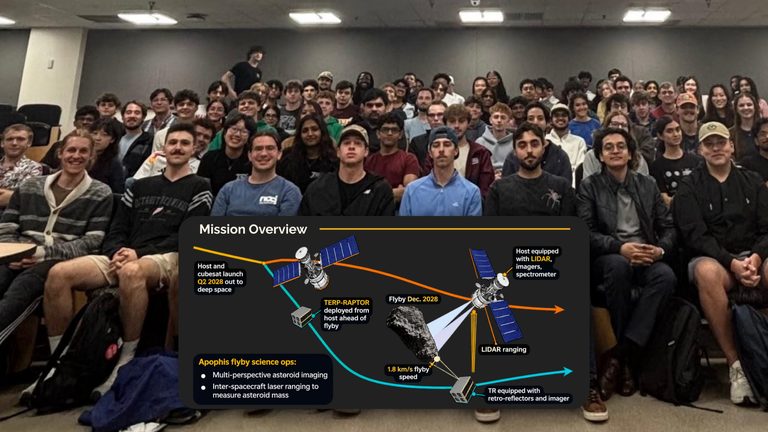
Prince George’s County is proud to see a team of over 90 University of Maryland students preparing a student‑built spacecraft to study asteroid Apophis ahead of its close approach in April 2029. The initiative, called TERP RAPTOR, is a collaborative effort that began as a graduate capstone class in 2024 and has grown into a 16‑subteam operation spanning freshmen to PhD candidates.
Mission goals and timeline
TERP RAPTOR plans to launch a CubeSat aboard a commercial rideshare in the second quarter of 2028. The satellite will deploy in December 2028, roughly three and a half months before Apophis reaches its nearest point to Earth. The mission aims to capture the first up‑close, multi‑perspective images of the asteroid, conduct a LiDAR‑based mass measurement using laser ranging between the CubeSat and its host spacecraft, and generate a detailed 3D model for the scientific community.
Partnerships and funding
The student team signed a Space Act Agreement with NASA’s Goddard Space Flight Center, becoming the first students ever badged under the agreement to work in dedicated lab space on‑site. Funding includes $380,000 from NASA and $46,000 raised through university crowdfunding. Additional support comes from George Mason University, which assists with propulsion testing, and The Aerospace Corporation, providing environmental testing and technical expertise.
Looking ahead
Throughout 2026 and 2027 the team will finalize designs and procure hardware before moving into assembly and testing. Beyond the Apophis mission, program leaders envision a permanent CubeSat program and a Space Mission Development Center in College Park, ensuring future cohorts graduate with real spaceflight experience.
This ambitious project showcases the talent and dedication of Maryland’s next generation of engineers and scientists, reinforcing the state’s role in advancing U.S. space exploration.
Original reporting: Arlington County | FOX 5 DC — read the source article.