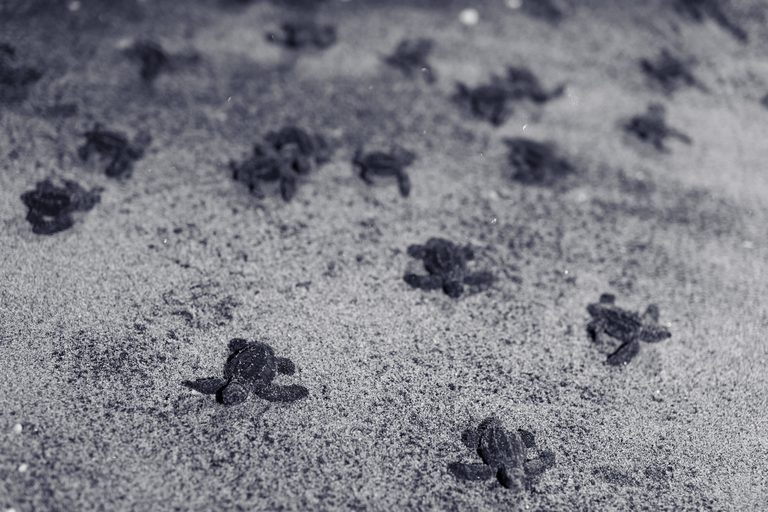
Seal Beach, Calif. – In a rare conservation success, more than 200 endangered olive ridley sea‑turtle eggs that were rescued from high‑surf threats on two Orange County beaches have hatched at the Aquarium of the Pacific. Early Saturday morning, wildlife officials released the tiny hatchlings into the surf under dark, low‑light conditions to give them the best chance of survival.
Rescue and incubation
In September, rising surf and the approach of tropical storms Rachel and Polo prompted federal and state wildlife agencies to act quickly. Teams from the U.S. Fish and Wildlife Service, NOAA, California Fish and Wildlife, and the National Oceanic and Atmospheric Administration excavated two nests – one near the Seal Beach National Wildlife Refuge and another by the Huntington Beach pier – removing 104 eggs from Seal Beach and 100 from Huntington Beach.
The eggs were transported to the Long Beach Aquarium of the Pacific, where they were placed in controlled incubators. “This is an unprecedented situation, and we’re proud to provide a temporary home for these eggs as they incubate,” said Dr. Lance Adams, the aquarium’s veterinarian. The incubation period lasted 58 days, after which the U.S. Fish and Wildlife Service announced that a number of the eggs had successfully hatched.
Release of the hatchlings
“We are excited to share that some of the olive ridley sea‑turtle eggs from Seal Beach successfully hatched after a 58‑day incubation period,” the agency posted on social media Saturday morning. Cassandra Davis, director of volunteer services at the aquarium, confirmed that staff and volunteers released the hatchlings from the beach in the dark early hours, minimizing light, human disturbance, and other distractions.
Once in the water, the newborn turtles entered a “frenzy period” – a frantic 24‑48‑hour sprint of continuous swimming powered solely by the yolk sac they absorbed before hatching. “Any hatchlings that do emerge will be released as soon as possible that night to preserve their limited energy reserves for the journey offshore,” the agency added.
Why this matters
Olive ridley turtles are the smallest of the sea‑turtle family, weighing up to 100 pounds as adults and measuring 2‑3 feet in length. They are listed as endangered, and successful hatching events on the U.S. West Coast are extremely rare. The two nests discovered in mid‑September represent the first confirmed natural sea‑turtle nests on the West Coast, according to the inter‑agency team overseeing the effort.
NOAA estimates that only about one in 1,000 sea‑turtle hatchlings survive to adulthood, with survival rates influenced by ocean conditions, predation, and fishing by‑catch. By moving the eggs to a safe incubation environment and releasing the hatchlings promptly, officials hope to improve those odds.
How the public can help
Residents who encounter stranded turtles can call the NOAA Fisheries West Coast Stranding Hotline at 562‑506‑4315. Sightings may also be reported via the NOAA Fisheries West Coast Facebook page.
The collaborative effort between federal, state, and local partners underscores the importance of proactive wildlife protection, especially as climate‑related storms increase the risk to vulnerable coastal species.
Original reporting: NBC4 Los Angeles — read the source article.