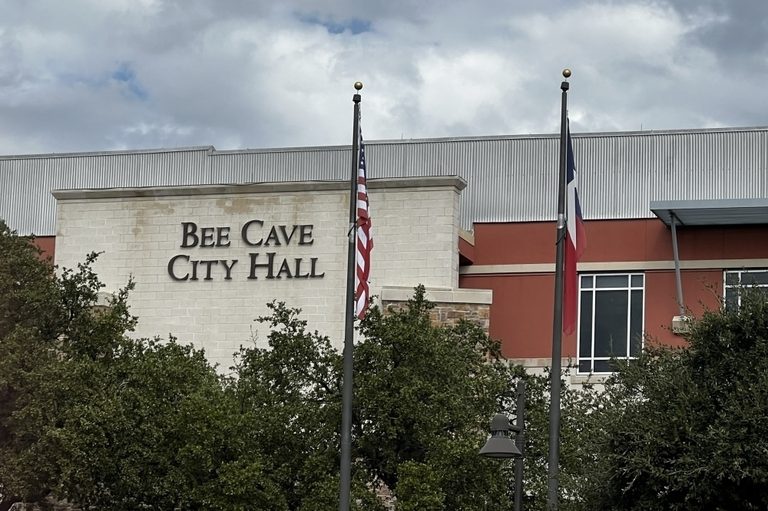
At the Nov. 10 Bee Cave City Council meeting, council members and public safety officials examined the city’s data‑sharing rules for its two Flock Safety Automatic License Plate Reader (ALPR) cameras installed at the entrance and exit of Central Park. The discussion centered on privacy protections, accountability, and the cameras’ proven value in law‑enforcement investigations.
How the cameras work
Flock Safety’s ALPR technology captures images of every vehicle that passes the cameras, then uses artificial intelligence to tag each photo with the license‑plate number, vehicle make, model, color and other distinguishing details such as dents or bumper stickers, according to Ian Leslie, public affairs manager for Flock Safety.
City policy and oversight
Bee Cave’s policy requires that ALPR data be used only for official purposes and shared solely for “legitimate law‑enforcement purposes,” said Police Chief William Pitmon. Officers must attach a qualifying case number to any request for data, ensuring that searches are tied to a specific investigation.
The department also operates a public “Flock Transparency Portal,” where residents can view data collected by the cameras, reinforcing the city’s commitment to openness.
Data‑sharing partners
Bee Cave shares its camera network with other Texas police departments that meet the same “bona fide” criteria, as well as with federal agencies, according to Chief Pitmon. Council member Kit Crumbley expressed confidence in the department’s handling of the system, noting that while other jurisdictions have faced reports of misuse, Bee Cave’s oversight appears robust.
Community perspectives
Mayor Kara King reminded the council that privacy expectations have evolved, stating, “Privacy doesn’t exist in 2026.” She cited a recent case in which Flock cameras helped locate a kidnapping victim across state lines, underscoring the technology’s life‑saving potential.
Resident John Wickens voiced support, saying, “I feel safer with the Flock … and I would really like to keep the cameras.” No opponents were recorded during the meeting.
Regional context
Recent reports indicate that several nearby cities—including Austin, Bastrop, Leander, Liberty Hill and Pflugerville—have ended contracts with Flock Safety. Bee Cave’s council directed staff to review those municipalities’ policies to inform any future decisions about the city’s own system.
Next steps
While no immediate action was taken, the council asked city staff to compile a comparative analysis of neighboring cities’ data‑sharing practices. The findings will be presented at a future meeting, allowing council members to determine whether any adjustments to Bee Cave’s policy are warranted.
Overall, Bee Cave officials emphasized that the ALPR cameras provide a valuable tool for protecting residents while maintaining transparent oversight—a balance that aligns with the community’s commitment to safety, personal liberty, and responsible governance.
Original reporting: Community Impact — Austin — read the source article.