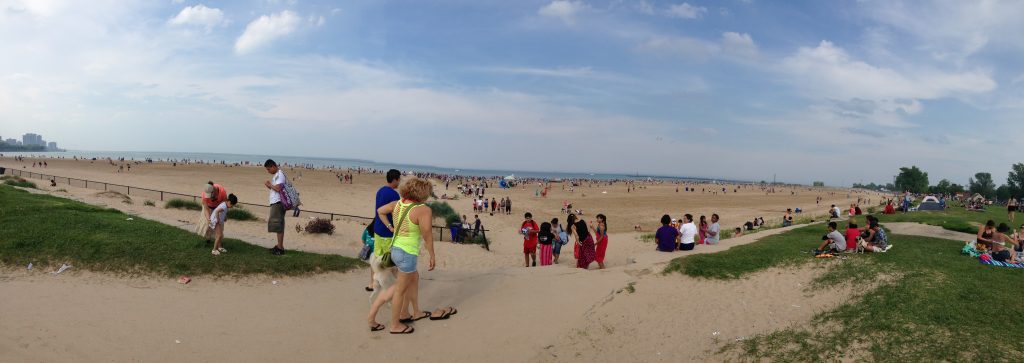
By seven in the morning on a Tuesday in October, the parking lot at Montrose Beach is already half full. That surprises people the first time. Dog walkers in heavy coats move along the waterline. A few older men fish from the stone break near the harbor. A woman does tai chi facing the lake, which is gray and enormous and doesn’t care about anything.
Montrose Beach sits at the northern end of Lincoln Park, right where Montrose Avenue dead-ends into Lake Shore Drive and then into sand. It’s a free public beach — Chicago’s beaches always are — and at roughly 15 acres it’s one of the larger ones along the lakefront. But what makes Montrose different from, say, Oak Street or Ohio Street isn’t size. It’s character. The place has accumulated layers over the years: the dog beach to the north, the natural dune restoration area behind it, the harbor with its small boats rocking in autumn, and the Bird Sanctuary — a low scrubby headland that draws serious birders during migration season, binoculars around their necks, speaking in low voices like they’re in church.
Migration is actually the best argument for visiting Montrose in September or October. The headland acts as a kind of funnel for birds moving south along the lakefront, and on a good morning you can see warblers, sparrows, and raptors in numbers that feel improbable this close to the city. The Chicago Ornithological Society runs occasional walks here; their website posts when and where to show up. Even if you know nothing about birds, it’s worth wandering into the sanctuary just to watch people who clearly love something deeply.
The dog beach — officially the Leash Free Area — opens in early April and runs through October. There’s a nominal annual permit fee, usually around $35, that goes toward upkeep. On a weekend afternoon it’s genuinely chaotic in the best way, dozens of dogs at the water’s edge, owners talking to strangers the way dog owners always do. Weekday mornings are calmer. The dogs still swim. The lake is still cold.
In summer, Montrose fills up fast on hot days, and parking along Montrose Avenue gets competitive by mid-morning. The CTA’s #78 bus runs along Montrose from the red line, which is worth knowing. The beach house has bathrooms and a seasonal concession stand. Kayak rentals are available at the harbor through Wateriders — a two-hour rental runs around $30 — and you can paddle north toward Wilson or south past the skyline depending on how the wind sits.
What the place resists is the postcard version of Chicago’s lakefront. It’s not especially manicured. The dune restoration area looks a little rough and sparse, which is exactly the point — that’s what this shoreline used to look like before development. Interpretive signs explain the plantings if you want to read them. Most people don’t, and that’s fine too.
There’s a particular quality to the light here on a clear fall afternoon, the city low and distant to the south, the water dark blue going to green near the sand. It’s the kind of place that holds up under repeated visits, different in every season, rarely the same twice. The Tuesday-morning fishermen know this already. They’ve been coming for years.