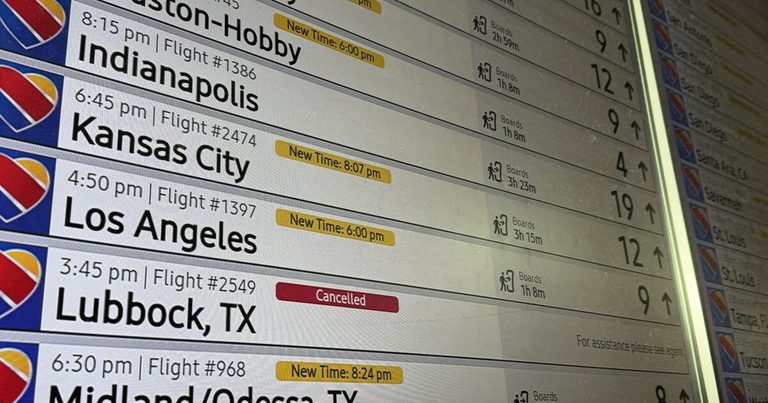
On Friday evening the Federal Aviation Administration cancelled a nationwide ground stop at 7:19 p.m., ending a rare shutdown that had halted departures at airports across Texas and the United States, according to San Antonio Report.
The order affected major Texas hubs, including Dallas‑Fort Worth International, George Bush Intercontinental in Houston, Austin‑Bergstrom and San Antonio International Airport. Flight tracking data from FlightAware showed nearly 1,000 flights delayed or cancelled at DFW and Houston alone: DFW reported 287 cancellations and 319 delays, while Houston logged 201 cancellations and 149 delays.
U.S. Transportation Secretary Sean Duffy told a press conference that instability in radar and communications systems—stemming from the nation’s aging air‑traffic‑control infrastructure—prompted the stop. He warned that restoring normal traffic would be “slow” and did not rule out a repeat, urging Congress to approve funding for a system upgrade. Duffy estimated a $50 billion price tag for the overhaul, adding another $30 billion would be needed to finish the work, and noted the White House is lobbying for the money.
In response to passenger concerns, Duffy clarified that the FAA, not the airlines, bears responsibility for the ground stop, meaning airlines are not obligated to provide lodging or meals. However, travelers who cancel because of prolonged delays remain entitled to refunds under FAA rules. San Antonio International Airport echoed the advice, urging travelers to check with their airlines for the latest information.
Department of Homeland Security Secretary Markwayne Mullin said investigators are looking into the cause and found no evidence of a “nefarious” act, emphasizing that the incident was not comparable to the September 11 attacks. Mullin noted the FAA’s new artificial‑intelligence program, which offers routing recommendations from a Washington, D.C., hub, is not linked to the outage.
Federal officials highlighted ongoing modernization efforts. Congress approved $12.5 billion last year to replace miles of copper wiring with fiber‑optic lines and to upgrade outdated radio systems at airports nationwide. Despite this progress, experts say more work is required. Former United Airlines pilot and aviation safety specialist Steve Arroyo told the Associated Press that similar regional outages in September were tied to old wiring, forcing controllers to halt planes on the ground.
The disruption also impacted local sports travel. The University of North Texas Mean Green flight to San Antonio for a game against UTSA was delayed, prompting the team to board a bus to the Alamo City. Fresno State arrived in San Antonio at 5 p.m. for its scheduled game in San Marcos. Duffy said the FAA will coordinate with teams to ensure they can meet kickoff times and encouraged schools to contact the agency directly.
This is the first nationwide ground stop since January 2023, when a key FAA computer malfunction forced a similar shutdown, and the first such action since the September 11, 2001 attacks. While the immediate halt has ended, officials warn that without full funding the aging system could cause future interruptions.
What’s next: The FAA expects to resume normal traffic patterns soon, but Secretary Duffy reiterated the need for Congress to approve the remaining $30 billion to complete the modernization. Travelers are advised to monitor airline communications for any further changes, and local sports programs should coordinate flight schedules with the FAA ahead of upcoming competitions.
Sources: sanantonioreport.org, ksat.com