Durham City Hall announced Thursday that a $1.65 million private investment from Duke University and the A.J. Fletcher Foundation will bolster the city’s Flexible Housing Assistance Fund. The funding will cover security deposits, application fees, essential household items and other barriers that often keep residents from securing stable housing.
According to The 9th Street Journal, the new money joins city and county contributions that total roughly $13 million earmarked for homelessness solutions this year. More than two‑thirds of that budget is directed toward flexible housing assistance and interim housing, part of a five‑year strategy that seeks to make homelessness in Durham “rare, brief, and non‑recurring” by mid‑2031.
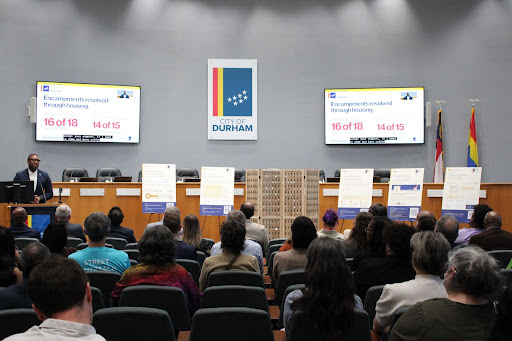
Since February, dozens of individuals have moved from homelessness to housing in Durham, including 50 children, as highlighted by a pegboard display of keys in the council chambers. City officials said the latest investment is intended to accelerate that progress, with a target of housing 400 people by June.
“After waiting a year or more for housing, people stop believing that the system can deliver,” said Ryan Smith, Durham’s director of community safety. “The strategy we’re here to talk about today, that Duke and A.J. Fletcher are investing in, aims and is built to change that.”
Mayor Leonardo Williams praised the partnership, noting, “This is what community looks like in Durham…We have a lot to celebrate, but it doesn’t come absent of our challenges.” Duke University Health System CEO David Zaas added, “It’s a bold goal, but together it’s achievable—to make homelessness rare and brief.”
More than 40 organizations contributed to the development of the city’s five‑year plan, including service providers, nonprofit partners and individuals with lived experience of homelessness. Anise Vance, assistant director of community safety, said the collaborative effort reflects years of advocacy and agency work.
Tasha Melvin, executive director of Families Moving Forward, emphasized the practical impact: “We’re going to house more families quickly…and we’re going to finally really address the number of families entering our homeless services system.” She warned that without the new investment, progress would be far slower.
The Flexible Housing Assistance Fund will use the private dollars to streamline the housing process, reducing wait times and ensuring that families and individuals can move into permanent homes within 30 days whenever possible.
What’s next: City officials will track placement numbers weekly and provide a public update on progress toward the 400‑person goal at the next council meeting. Residents are encouraged to support ongoing efforts through volunteer opportunities and donations to partner nonprofits.
Sources: 9thstreetjournal.org