Alpine, Texas – On November 6, the United States Supreme Court declined to block the Trump administration’s plan to construct a border wall that would cut across the Big Bend region of Brewster County. The decision has reignited the No Big Bend Wall movement and raised fresh concerns among local business owners, former park officials, and community leaders who rely on tourism and natural‑heritage preservation.
Local economy on edge
Big Bend National Park is the centerpiece of Brewster County’s economy, drawing visitors from across the nation to its dramatic desert landscapes, the Rio Grande, and iconic hiking trails. Residents say the wall threatens to divert traffic away from the park, reducing the flow of tourists that sustains restaurants, lodging, and small‑scale enterprises.
Greg Hammer, who runs Boathouse Bar & Bungalows in the historic Terlingua Ghost Town, warned that the wall could spell the loss of his livelihood. “I’ll likely lose my small business. It’s that simple. There will be ripple effects that result from a decrease in tourism that will likely destroy a number of small businesses throughout the region,” Hammer said.
Conservation concerns
Raymond Skiles, a former wildlife biologist for Big Bend National Park and current wilderness coordinator living in Alpine, emphasized the ecological stakes. He argued that the wall would scar a landscape that has existed for roughly 90 million years, damaging wildlife corridors, native vegetation, and the geological integrity of the Rio Grande corridor.
“To go blasting and bulldozing a route along what you know many of us would call the most scenic and ecologically important… could just take a wrecking ball to a real national treasure affecting wildlife, native vegetation, the geology even that has been there for, you know, 90 million years in most cases,” Skiles said.
Community response and political action
Local activists have organized under the banner “No Big Bend Wall.” Yolanda Alvarado, regional director of the group, said the organization will pursue legislative avenues to protect the region. “We’re gonna be working with lawmakers all the way to the federal level to make sure our region is protected, and what they’re doing is lawful because West Texans deserve the same property rights as any American,” Alvarado asserted.
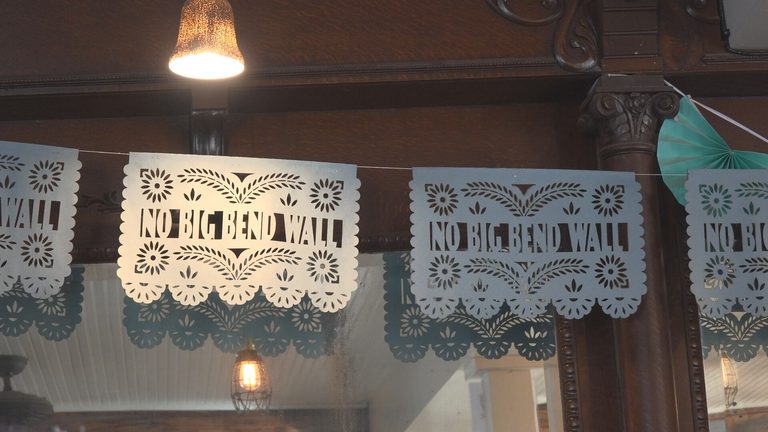
Murals, posters, and grassroots gatherings have appeared throughout the Big Bend area, signaling a unified front against the wall. While the Supreme Court’s decision leaves the project legally viable, the visible opposition suggests that political pressure may continue to mount at both state and federal levels.
Federal policy context
The wall is part of the Trump administration’s broader immigration‑enforcement agenda, which emphasizes securing the nation’s borders through physical barriers and increased patrols. Supporters argue that a wall deters illegal crossings and protects American communities, while opponents contend that it harms the environment, disrupts local economies, and infringes on property rights.
President Trump has repeatedly framed border security as essential to national sovereignty and public safety, a stance that resonates with many voters in West Texas. The administration maintains that the wall will be built in a manner that respects private property and follows applicable regulations.
What’s next?
With the Supreme Court’s ruling, the next steps involve detailed engineering studies, land‑acquisition negotiations, and potential litigation from landowners or environmental groups. Residents and advocacy organizations say they will monitor each phase closely, ready to challenge any actions they view as unlawful or harmful.
For now, the Big Bend community watches closely, hoping that economic vitality and the preservation of one of America’s most treasured natural landscapes can be balanced with the federal government’s border‑security objectives.
Original reporting: CBS7 / First Alert 7 KOSA (Gray) — read the source article.