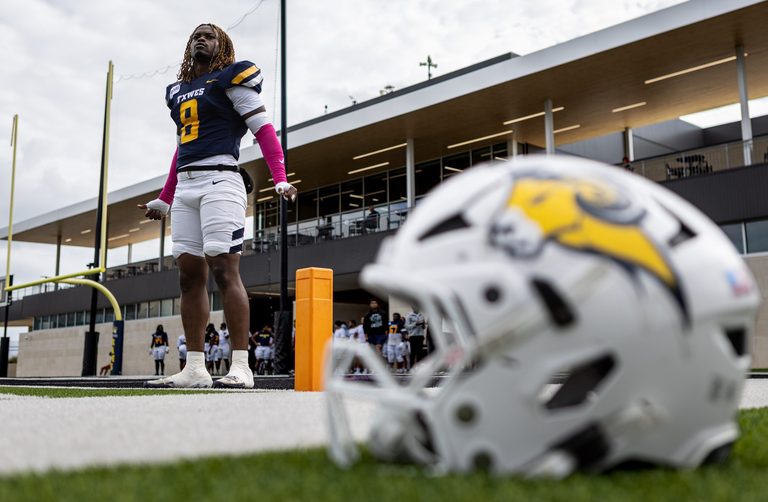
The steady rhythm of jackhammers and construction cranes now fills the west side of Texas Wesleyan University’s Fort Worth campus. The $16.5 million Karen Cramer Stadium, featuring artificial turf, a press box and 3,500 seats, is slated for completion this winter, bringing home football games to campus for the first time in 2027.
Why football matters to the university
Since trustees voted to revive football a decade ago, the Rams have practiced at the on‑campus stadium but traveled to Crowley ISD Multi‑Purpose Stadium for home games. University leaders see a move to NCAA Division II as a catalyst for student recruitment, alumni engagement and community involvement. Athletic director Ricky Dotson notes that football gives students a team to rally around and creates visible connections between athletes and classmates.
Growth goals tied to athletics
Texas Wesleyan enrolled 2,955 students this fall, including a record 511 first‑year students. The university aims to reach about 3,500 students within five years – a 25 % increase – and attributes part of that growth to expanded academic programs, student support services and the heightened profile that a competitive football program provides.
“Our goals are growth, but it’s not crazy growth,” said Lauren Findley, vice president of enrollment management. “We’re building intentionally so we can grow with it.”
From a historic hiatus to recent success
The Rams played their last game in 1941 before World II halted the program for more than seven decades. Football returned in 2017, and after early struggles the team posted a 7‑3 record in 2021 and captured four straight Sooner Athletic Conference titles from 2022‑2025, including an undefeated regular season in 2024.
President Emily Messer recalled seeing the team’s success reflected in local sports headlines, noting that winning seasons sparked broader community interest.
Facilities and student experience
Beyond the stadium, the university opened the Moritz Fieldhouse, providing lockers, treatment rooms, showers and laundry facilities for athletes. New weight rooms, coach offices and meeting spaces have been added, improving daily life for players and staff.
Recruiting efforts now reach across Texas and beyond, with coaches traveling to Houston, West Texas and San Antonio and setting up satellite camps. Recent recruits, such as running back Ian Jernagin from Bakersfield, cite small class sizes and approachable professors as key draws.
Financial snapshot
Football expenses for the 2025‑26 fiscal year totaled $1,628,421, roughly one‑fifth of the university’s overall athletics budget. The program generated $1,842,615 in revenue, covering scholarships, coaching salaries, recruiting and travel costs.
Community impact
Local families are already feeling the difference. Defensive back Evenn Head, a 2023 recruit, enjoys a short commute from Hurst and sees his parents and extended family at games. Tony Hartnett’s son, Nick, a backup left tackle, says playing for the Rams “means everything” for his family.
As the stadium nears completion, the university anticipates more Fort Worth residents attending games, boosting local businesses and reinforcing Texas Wesleyan’s role as a community hub.
Original reporting: Fort Worth Report — read the source article.