By: James Matlock
Electronic voting machines and the systems that support them introduce risks that hand-marked paper ballots do not. These risks are documented in supply-chain studies, congressional testimony, independent security analyses, and the everyday behavior of complex digital devices. The most transparent and auditable remedy is to return to hand-marked paper ballots as the sole official record, hand-counted at the precinct where they were cast, and retained there under local bipartisan control.
Foreign Components and Supply-Chain Exposure
The three companies that supply the large majority of U.S. voting equipment have acknowledged that certain components come from China. In 2020 testimony before the House Administration Committee, executives from ES&S, Dominion, and Hart InterCivic confirmed Chinese-sourced parts—programmable logic devices, capacitors, resistors, screens, and related items—because no domestic alternatives existed for some of them. A 2019 Interos analysis of one widely used machine found roughly 20 percent of components linked to China-based suppliers. Final assembly may occur in the United States, and vendors describe testing, but the hardware still depends on a manufacturing base controlled by a strategic competitor. No public evidence has shown these parts altered vote totals. The dependency itself does not exist when the ballot is a piece of paper marked by the voter and counted by hand at the precinct.
Residual Connectivity: When “Off” Is Not Fully Off
Modern smartphones show a basic problem with digital systems. Turning Wi-Fi “off” in the quick-settings panel often only disconnects the current network. Background scanning, automatic reconnection to known networks, and location-related scanning can continue. Settings such as “Turn on Wi-Fi automatically” re-enable the radio under certain conditions. The visible off state does not guarantee every wireless function is inert.
Voting equipment raises the same question. Many precinct tabulators are designed to be air-gapped while polls are open, with results moved by physical media. Some models have included optional cellular modems for transmitting unofficial results after polls close. Vendors describe private networks and post-close activation, yet researchers have warned that any network connection creates additional attack surfaces. Some commercial hardware has had wireless capability present but disabled in software; the capability was still there. When officials say a machine is “not connected,” the phone analogy shows why precise, verifiable answers matter more than assurances. Hand-marked paper counted at the precinct eliminates the issue entirely.
Removable Media and the Limits of Trust
USB drives and memory cards are routinely used to transfer results from air-gapped machines. Claims that inserting or removing a stick is the primary method of large-scale fraud, or that removal causes machines to “revert” to hidden programming, have not been supported by audits that withstood scrutiny. Many viral videos have been explained as routine transfers. At the same time, any system that depends on proprietary software and removable media requires the public to trust that the software behaved correctly and that the media was never altered. Hand-marked paper ballots counted by hand at the precinct remove that layer. The voter’s mark is the record; local observers can watch the count; the ballots stay where they were cast.
Remote Systems and List Maintenance
Companies such as Democracy Live provide cloud- and tablet-based tools mainly for military, overseas, and disabled voters. Independent analysis has identified serious risks with full electronic ballot return, including opportunities for undetectable manipulation. These tools may serve access needs, but they are not a substitute for a paper record the voter verifies and that is counted and retained locally. Interstate systems such as ERIC perform list-maintenance matching; they do not cast or count votes. Accurate rolls matter, yet they do not justify electronic tabulation or centralized electronic handling of the ballots themselves.
What Actually Verifies an Election
State and local officials run elections. Federal agencies provide voluntary assistance. Neither changes the core problem: complex electronic systems contain components, software, and optional connectivity that ordinary citizens and most election officials cannot fully inspect. Hand-marked paper ballots counted by hand at the precinct and retained there eliminate most of those variables.
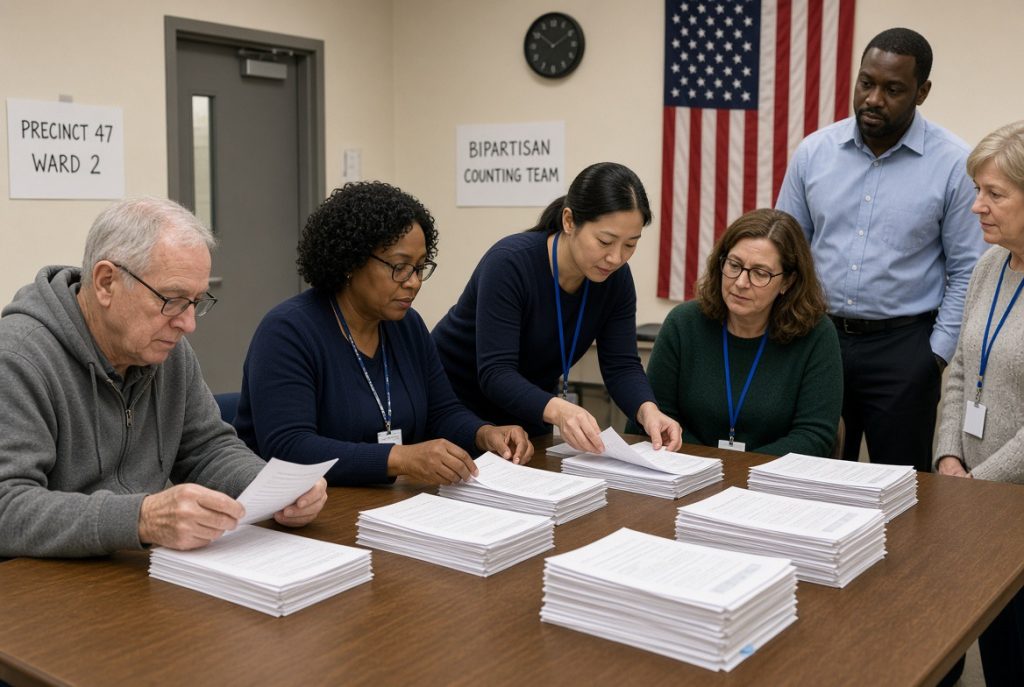
Counting at the precinct level means the ballots never leave the place where voters cast them until the local count is complete and observed. Retention at the precinct (or immediately under continuous local bipartisan custody) shortens the chain of custody, reduces opportunities for loss or substitution during transport to a central facility, and allows local residents to observe the process from start to finish. Hand-counting is slower than machine tabulation and can introduce human error if procedures are weak; those risks are managed with bipartisan teams, public observation, clear written procedures, and optional secondary checks. They are smaller than the risks of opaque software, foreign components, and residual wireless capability that cannot be fully audited by the public.
Risk-limiting audits remain useful as a check, but when the official count is already a hand count of paper ballots performed in public at the precinct, the need for complex electronic reconciliation disappears. Bipartisan observers can watch every step. No foreign supply chain, no modem, no cloud portal, and no proprietary firmware stands between the voter’s mark and the final tally.
The Practical Case
Hand-marked, hand-counted paper ballots retained at the precinct are slower to report on election night and require more local labor. Those are real costs. They are smaller than the costs of persistent public doubt, repeated litigation over black-box systems, and the ongoing need to defend supply chains and software that most voters cannot examine. Returning to this system does not require proving that every past election was stolen. It requires only recognizing that the risks of electronic systems are real, the opacity is unnecessary, and the remedy is straightforward and local.
The voter’s mark on paper, counted by hand under observation at the precinct where it was cast, and retained there, is the system that needs the least trust and offers the most transparency. Everything else is an extra layer that can fail, be compromised, or simply remain opaque. That is reason enough to do away with voting machines as the official record and return to hand-marked, hand-counted paper ballots retained at the precinct level.