Teresa Sobieski did not set out to run a restaurant. She set out to find a decent kielbasa, failed, and apparently decided the logical response was to open her own place. That was eleven years ago. She still makes the kielbasa herself.
Sobieski’s European Deli & Café sits in a low-slung strip center off Valley Ridge Boulevard, sharing a parking lot with a tire shop and a tax preparer. The signage is small. The hours are posted on a hand-laminated sheet taped to the door. If you are hoping for atmosphere in the design-forward sense, recalibrate now.
What you get instead is a narrow deli case packed with house-cured meats, imported mustards, a stack of rye breads baked Tuesday and Friday, and Teresa, who will almost certainly ask where you heard about the place and then correct something the person told you. She is not warm in the way that hospitality trainers mean. She is warm in the way a person is warm when they have been feeding strangers for over a decade and have mostly made peace with it.
The menu is short on paper and longer in conversation. There are cold plates — cured meats, pickled beets, cucumber salad dressed with sour cream and dill — and a rotating set of hot daily specials written on a whiteboard above the register. On a recent Wednesday, that meant żurek, a sour rye soup with hard-boiled egg and sausage, and bigos, the Polish hunter’s stew that takes two days to build properly and tastes like it. Both were $11. Both were the kind of thing that makes you slightly resentful you don’t live closer.
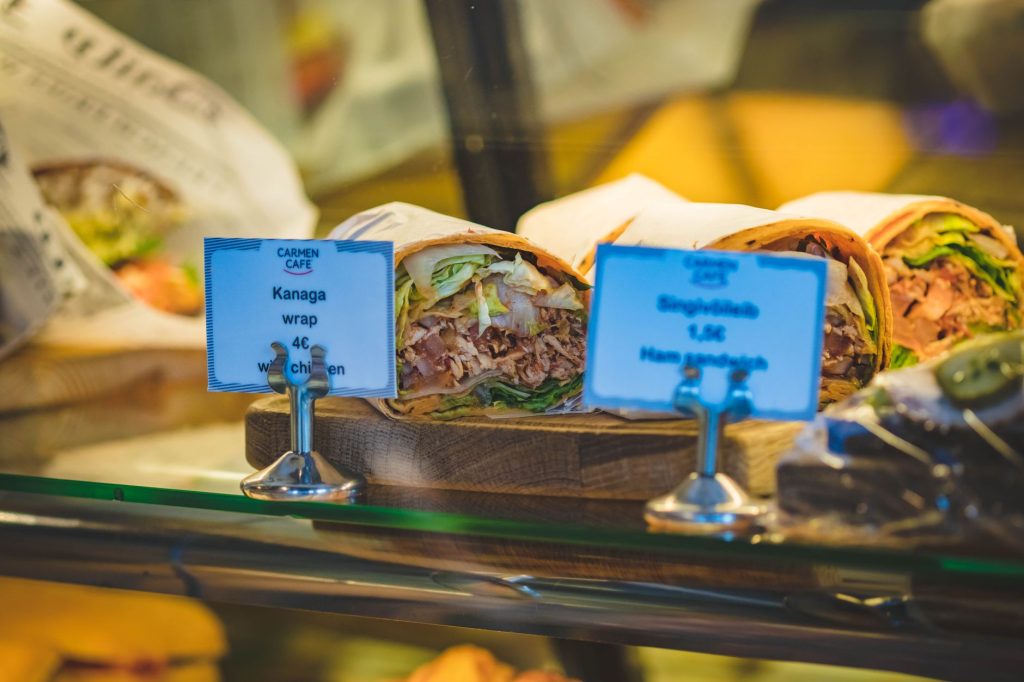
The kielbasa sandwich — a split link on rye with whole-grain mustard and a smear of horseradish butter — runs about $9 and is the safest recommendation if you are coming for the first time and don’t want to explain yourself to anyone. It is also excellent. The sausage has actual snap to it, the kind that disappears when meat is mass-produced, and the rye has that particular density that makes grocery-store bread feel like a prop.
Teresa’s daughter, Marta, handles most of the counter during the lunch rush, which peaks early — by noon the soup is usually half gone, and by 12:45 on a weekday the bigos can be a lost cause. Plan accordingly. The café seats maybe sixteen people at four tables, and there is no table service; you order at the counter, grab a number, and find a seat. Cash is preferred, though they take cards with a small-fee caveat that Teresa will mention matter-of-factly and without apology.
The deli case is worth a slow look if you have time. Beyond the kielbasa, there are smoked pork loins, a head cheese that intimidates most people, and rotating specials like pickled herring in cream sauce or duck pâté. Everything is labeled in English and Polish, which is either charming or slightly confusing depending on your familiarity with the diacritics. Take-home prices are reasonable — a half-pound of the smoked loin runs around $7, and the rye bread is $5 a loaf.
Lewisville does not have a large Polish community, which makes Sobieski’s existence a little hard to explain on paper. Teresa has mentioned, more than once, that she expected to close within the first two years. She seems genuinely puzzled that she did not. The regulars, a mix of Eastern European expats from the broader DFW area and Lewisville locals who stumbled in and stayed, do not seem puzzled at all.
Lunch only, Tuesday through Saturday. Get there before noon if you want the soup.