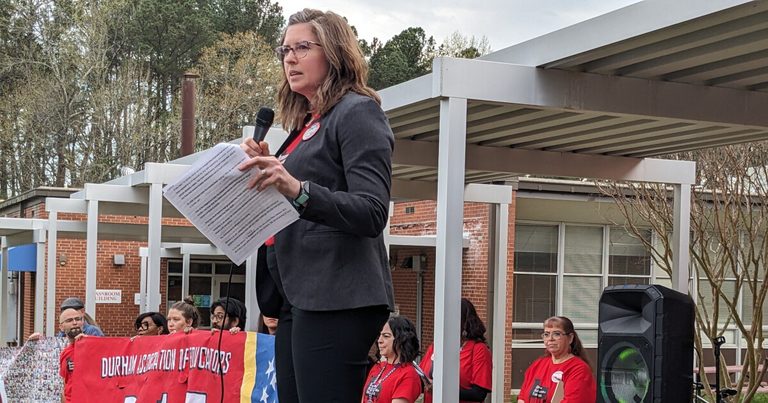
Durham public‑school employees are using the district’s meet‑and‑confer policy to demand six priority changes, according to WUNC education reporter Liz Schlemmer. The local chapter of the North Carolina Association of Educators, now representing a majority of teachers and support staff, is seeking protected planning time on required work days, consistent extra‑duty pay, hazard pay at time‑and‑a‑half for staff who must enter buildings during closures, and the ability to work from home on non‑required days.
President of the Durham Association of Educators, science teacher Mika Hunter Twietmeyer, said the group wants “extra pay for extra work” to be applied uniformly across sites, noting that many staff are covering double caseloads because of vacancies. She added that hazard pay would apply to a few employees per building who shovel walkways or check refrigerators during emergencies.
Twietmeyer acknowledged that the district has not yet quantified the cost of these proposals and warned that without funding the district might consider school closures. She said the association is using the budget‑transparency policy, won last year, to identify spending that does not directly benefit students.
At the same time, Durham’s water supply is in a precarious state. James Lim, the city’s water‑efficiency manager, told WUNC that the city has “78 days of easily accessible water and a total supply of 147 days,” based on current reservoir levels and assuming no additional inflow. The two main reservoirs, Lake Mitchie and Little River, sit at roughly one‑third of capacity after receiving only 0.16 inches of rain in the past month.
Durham entered stage 2 water restrictions in June and could move to stage 3, which would pause outdoor watering, if supplies continue to dwindle. To augment local sources, the city is purchasing 2 million gallons per day from the Orange Water and Sewer Authority, drawing about 9 million gallons per day from its Jordan Lake allocation via the Town of Cary, and pulling 3‑4 million gallons per day from emergency storage at Teer Quarry.
Both the educators’ push for better compensation and the city’s water‑conservation efforts underscore the challenges Durham faces as enrollment declines and drought conditions intensify. Residents are urged to follow the city’s water‑use guidelines—limiting irrigation, fixing leaks, and taking shorter showers—to help stretch the limited supply.
What’s next: The school board will consider the educators’ six demands at its next monthly meet‑and‑confer session, while the city’s water‑management team will monitor reservoir levels and may announce stage 3 restrictions if the 78‑day supply outlook worsens.