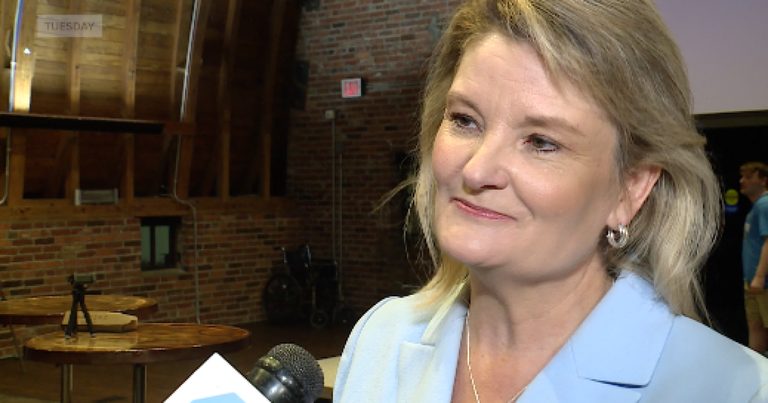
Democrat Cindy Holscher has been elected governor of Kansas, beating Republican state Senate President Ty Masterson. The victory keeps the governor’s office in Democratic hands and adds to a broader national trend of Democratic wins in state executive races.
Local support drives the win
Holscher, a state senator from Johnson County, captured more than 60% of the vote in the county, offsetting Masterson’s strong margins in rural, traditionally Republican areas. Johnson County, home to roughly 23% of Kansas’ two‑million voters, has been trending Democratic since President Trump’s first campaign in 2016, and Holscher’s performance reflects that shift.
Campaign priorities
During the campaign, Holscher pledged to place a moratorium on new data centers for artificial intelligence, arguing that Kansans want limits on energy and water use and that any new facilities should create local jobs. She framed the issue as a common‑sense request from residents across the state.
Masterson, who entered the race with President Trump’s endorsement, focused on cutting property taxes, improving public safety, and strengthening schools. He promised to continue fighting for lower taxes, a message that resonated with many rural voters.
Broader Democratic momentum
The Kansas race follows a series of Democratic victories nationwide, including the election of U.S. Sen‑elect Adam Hamilton, a pastor of the nation’s largest United Methodist church, marking the first Democratic Senate win in Kansas since 1932. In addition, Democrat Chris Mann unseated Attorney General Kris Kobach, a former vice‑chair of President Trump’s 2017 commission on election integrity.
These outcomes come as the Republican Governors Association spent $19 million on television and digital ads, outspending Democrats more than three‑to‑one overall. Despite the spending advantage, the Democratic message on local issues and the growing suburban shift proved decisive.
Transition and outlook
Holscher will succeed outgoing Governor Laura Kelly, who was term‑limited after two terms. Kelly, also a Democrat, initially expressed reservations about Holscher’s candidacy but later endorsed her and produced a campaign video.
In a video posted two days before the race was officially called, Holscher said, “Kansans have sent a clear message that they want to keep our state moving forward. The work of preparing to lead has already begun.” The administration she inherits faces the challenge of balancing rural concerns with the evolving priorities of the state’s growing suburban electorate.
What’s next for Kansas
With the new governor in place, Kansas will see continued focus on issues such as property‑tax reform, public‑safety funding, and the debated data‑center moratorium. The administration’s early statements suggest a willingness to work across party lines to address the state’s economic and infrastructure needs.
Original reporting: KSHB 41 Kansas City (local) — read the source article.