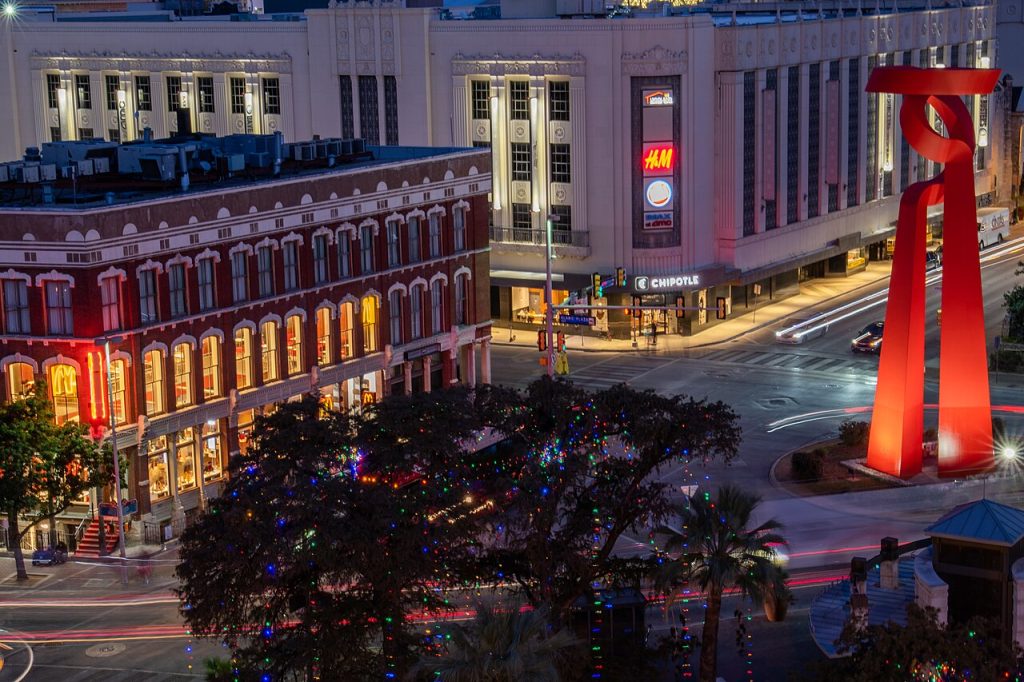
The Torch of Friendship is a 65-foot bronze sculpture that most San Antonians drive past without stopping, situated on a triangular traffic island where Commerce Street meets I-35, just at the edge of downtown. It has been there since 2002, a gift from Mexico to the city, and it looks like nothing else in Texas — a twisting flame shape cast by sculptor Sebastián, rising orange and rust-colored against whatever sky happens to be behind it that day.
On a weekday morning, before the lunch crowd pushes through downtown, the area around it is calm enough that you can actually walk the perimeter and look at the thing properly. That’s worth doing. The sculpture isn’t just decorative. It was placed deliberately, at a point where travelers historically entered the city from Mexico via the old Camino Real. That context matters. The torch isn’t commemorating a battle or a politician — it’s about a relationship between two countries, rendered in abstract form by a Chihuahua-born artist who wanted the shape to suggest movement and exchange rather than permanence and pride.
Sebastián, whose full name is Enrique Carbajal González, designed the work in collaboration with the city of San Antonio and the Mexican government. The unveiling involved then-President Vicente Fox. That backstory gets lost because the sculpture sits in one of those spots that urban planning sometimes produces: technically accessible, practically ignored. There’s no parking lot. No gift shop. No interpretive signage you’d actually stop to read. You pull off, you look, you leave.
That’s fine. Some landmarks earn their place precisely by not demanding anything from you.
The best time to visit is early morning in late fall or winter, when the low sun catches the patinated bronze and the air is cold enough that downtown feels a little emptier than usual. The sculpture faces southeast, so the light works in your favor before 10 a.m. Photographers who want the city skyline in the background will find a decent angle from the Commerce Street side. Foot traffic is light. The whole visit takes maybe fifteen minutes if you’re being thorough.
There’s no admission, obviously. The land around it is public right-of-way. Street parking on Commerce exists but is metered during business hours; the easiest approach is to walk down from one of the nearby parking garages if you’re already in the area. The Convention Center, the River Walk access points, and the edge of La Villita are all within a few blocks, so it fits naturally into a longer downtown morning without requiring any special trip.
What makes it worth mentioning isn’t that it’s overlooked — plenty of things are overlooked. It’s that the sculpture itself is genuinely good. Sebastián has work in public collections across Europe and Latin America, and this piece doesn’t embarrass that resume. The form holds up under long looking. The color shifts depending on weather and light. On a gray January morning, it reads almost dark brown. In direct sun it goes orange-red, and the twisted upper section catches shadows that change as clouds move.
San Antonio’s relationship with Mexico is long, complicated, and central to what the city is. This sculpture doesn’t simplify that history or dress it up. It just marks it, quietly, on a traffic island off I-35. That restraint is part of what makes it worth a few minutes of your time.