The Turnip & The Tool
The underestimated, underutilized and misunderstood case study
There’s a cooking scene in a movie called Last Holiday. It’s between Georgia Byrd (played by Queen Latifah) and Chef Didier (played by Gérard Depardieu). Georgia is standing in the commercial kitchen of a sensational mountain resort with Chef Didier. She is surprised to see him braising common red turnips he intends to serve to the elitist resort guests.
Stay with me. There’s a business point to this story.
Chef Didier looks at Georgia and says, “The poor baby turnip, nobody likes them.” He continues, “Of course, life is easy if you are a truffle or *bleep* mushroom, but the turnip is to be loved because she’s a self-made woman of vegetables. All the others, you can only destroy with cooking, but the turnip, she gets better.”
It was because of this movie scene that I started cooking turnips and incorporating them into more meals. It turns out, turnips are a great addition to certain meals when you know how to cook them.
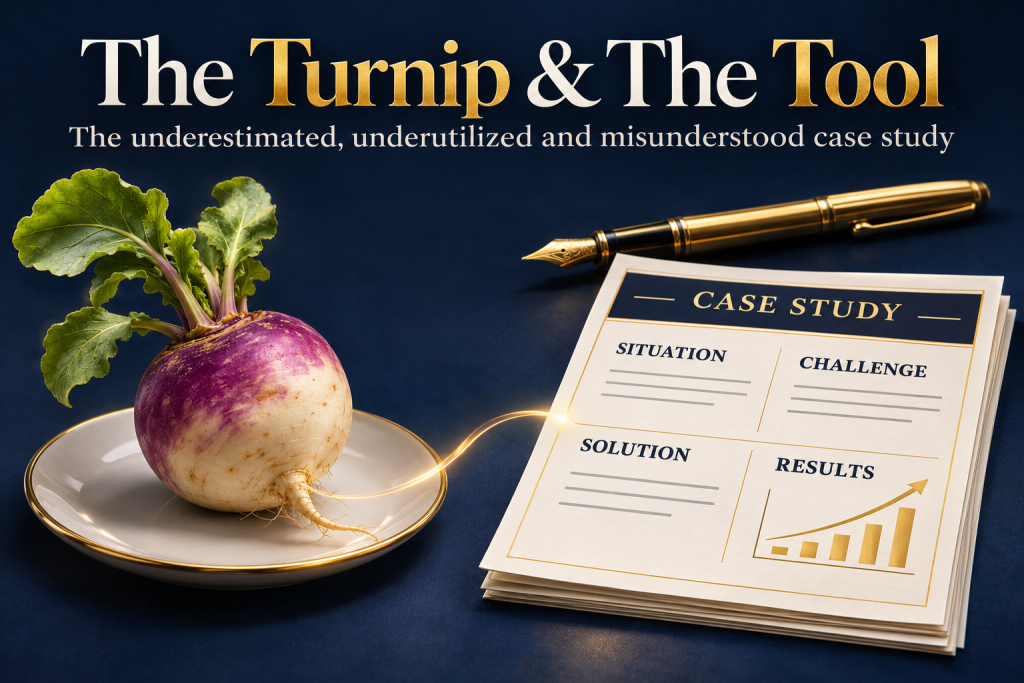
I feel about well-written case studies the same way Chef Didier felt about turnips. Case studies, like turnips, are often underestimated, underutilized and misunderstood. And like the turnip, a case study gets better the more skillfully you prepare it. So, before you dismiss case studies as a reliable promotional resource and lead-generating tool, hear me out.
First, it’s important to understand what a case study is and isn’t. Too often, case studies are confused with testimonials. Testimonials are great for online ratings of your products or services for Yelp, for example. However, they are often driven by emotion, making them prone to hyperbole and/or fluff without facts. Customers who had a great experience with you may tell stories about how nice your staff —which is wonderful, but subjective.
Here are a few illustrative testimonials (not actual customer quotes).
★★★★★ “Absolutely amazing!!”
Best experience EVER. The whole team was so friendly and made us feel like family. I would give 10 stars if I could. Highly recommend to everyone!
— Karen M., about a local roofing company
★★★★★ “So glad we found them”
From the moment we walked in, we knew we were in good hands. Super professional, super nice, and they really care. Five stars all day long!
— The Alvarez Family, about a dental office
★★★★★ “Worth every penny”
Honestly the best decision we made this year. Results were incredible and the service was top-notch. Thank you, thank you, thank you!
— Mike R., about an IT services firm
★★★★☆ “Great people”
Took a little longer than expected, but they were so sweet about it that I didn’t mind. Would use again.
— Linda S., about a home remodeler
Positive or negative, a testimonial often communicates how someone felt. The positive ones are generally warm, enthusiastic and fact-free. The negative ones often emote frustration, anger and sling arrows at a company but seldom explain why.
A case study documents a specific issue creating a challenge for a company then uses measurable facts to prove a positive outcome because of your product or service. Case studies are specifically structured to deliver fact-based information and clearly defined outcomes.
It has four parts: identify a specific problem, explain the impact the problem is having on the company, provide specifics on the solution presented to solve the problem, and deliver fact-based results realized after applying the solution.
Here are some of the case studies I’ve created to demonstrate to prospective clients that my end game includes tangible results:
Case Study: ABC Financial Services (name changed)
Situation: A spirited leader of a highly successful financial planning firm finds he can no longer recruit more than four or five people to his prospecting dinners.
Challenge: The community now has three times more competitors than when the business first started, and prospects have tuned out the same dinner invitations – the same recipients no longer respond to the direct mail campaigns.
Strategy: Jet and her team proposed buying a custom list to expand the firm’s exposure to new prospects fitting the financial company’s customer profile. The prospects were presented with a clear value proposition: are you rolling the dice with your retirement? It was delivered in a tube mailer with dice and a custom rolled-up message inside that grabbed recipients’ attention.
Results:
• Both events sold out.
Case Study: A Tribal Economic Development Authority
Situation: A Tribal Nation’s economic development authority launched a national vehicle fleet program for corporations, organizations and Tribal Nations.
Challenge: Despite its global vehicle capabilities, the fleet program could not provide individual Native Americans or Alaska Natives with vehicle purchasing options; did not have financing options that gave Tribal members (with good or compromised credit) the chance to purchase a car; and could not supply an abundance of vehicle options to Tribal members in more remote areas, as it was only equipped to sell new vehicles.
Strategy: Jet sought out and negotiated a national contract for the fleet program with one of the nation’s largest automotive retailers – a $14 billion company – for a teaming venture.
Results:
• The fleet program could then offer an online program for purchasing vehicles
(nationwide) for Native Americans, Alaska Natives and their families.
• Rather than a single dealership, the program enables Tribal members to shop an
inventory of more than 50,000 cars, trucks and SUV options.
• The program ensures multiple sources of financing.
• Shoppers have 24/7 toll-free phone support and can purchase pre-owned, not just
new, vehicles.
Case Study: Texas-Based Consulting Company
Situation: An established boutique executive coaching company offered a proprietary profiling system designed to develop emotional intelligence and improve professional performance.
Challenge: Expanding the customer base into new industries.
Strategy: Jet applied her expansive relationship network and the substantive nature of the consulting company’s distinctive value to secure new clients in new regions.
Results:
• Brokered a deal with a new Fortune 300 biomedical client.
• Brokered a deal for a new food & beverage industry with more than 100 locations.
By the very nature of its structure and brevity, the case study presents data (not emotional opinions) and a substantive case for the value of a product or service via quantifiable conclusions. To a certain extent, the case study, when written properly, can serve as a truncated white paper of sorts, rationally presenting the merits for using a specific service or product. This can especially be an effective marketing option for potential customers with limited time or a savvy follow-up mechanism for prospects with short attention spans but high performance expectations.
Put case studies to work for you.
1. Sales follow-up. Leave one behind after every presentation, or email it the next morning with a one-line note: “Here’s what we did for a company a lot like yours.”
2. Proposals. Put one or two case studies in every proposal, matched to the prospect’s industry or problem.
3. Your website. Give them their own page. Place one next to every service you sell.
4. Social media. Turn each case study into a short post: the problem in one line, the result in one number.
5. Your newsletter. Feature one case study per issue.
6. Trade shows. Run them on a screen in your booth, and hand out printed copies to serious prospects.
7. Speaking engagements. Tell the story from the stage, then offer the one-page version afterward.
8. Media pitches. Reporters want facts and outcomes. A case study gives them a ready-made story.
9. Award entries. Most business award applications ask for exactly what a case study already contains.
10. Your own team. Use case studies as a training tool for new hires.
Graphic enhancements can be added to a case study to reinforce your brand while also highlighting the distinctive, quality attributes of your offerings. Here are two examples redesigned with industry-inspired graphics and company names withheld. The facts and results remain the same; the presentation makes their value easier to see.
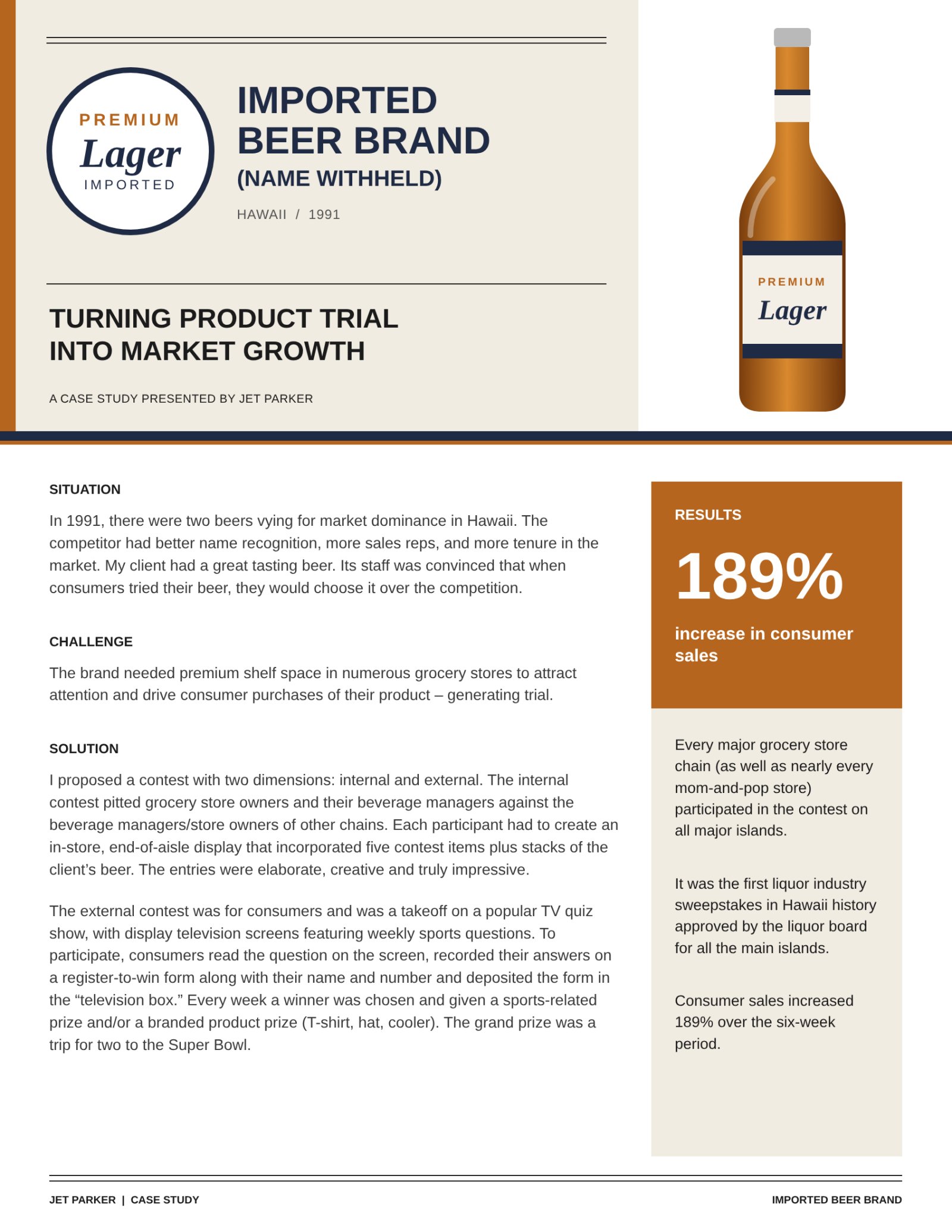
There is nothing like results to entice a prospect to inquire about your services or products.
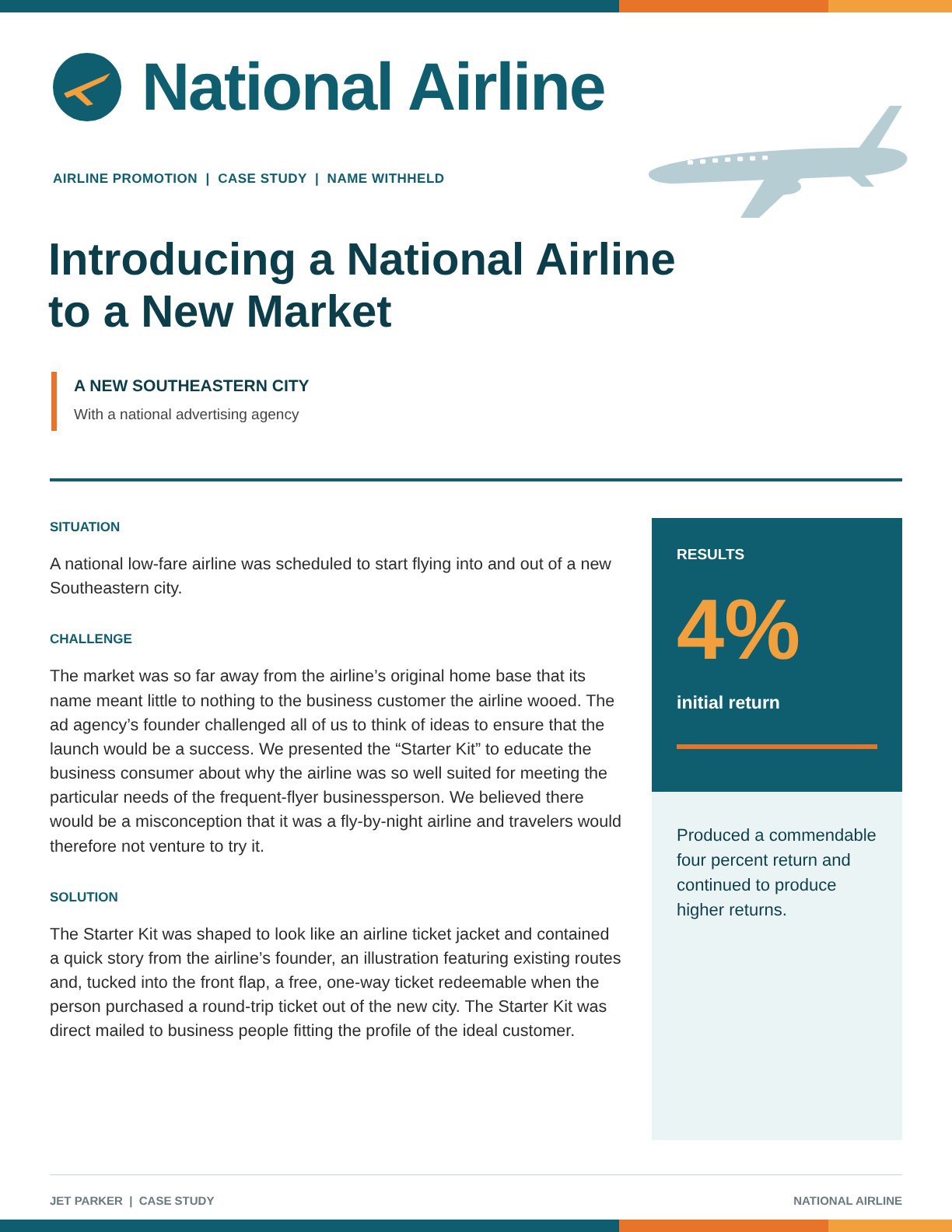
This airline launch campaign was created by a national advertising agency. I helped develop the Starter Kit as part of that effort. I tell more of this story in my book, ABCs for CEOs.
The little case study, like the tiny turnip, can pack a punch – succinctly. So, don’t underestimate the power of this great side dish.
Questions:
Are you using case studies in your marketing and selling arsenal?
Are you presenting case studies disguised as testimonials?
Do you showcase your case studies on your website and in your social media campaigns?
Jet Parker, Chief Abundance Officer of CEO Wired, hosts the Wired to Spark podcast and writes the CEO Wired and Beyond the Ballot columns for HyperLocal Loop. A CEO, author and strategic advisor with more than 30 years of experience, she co-founded Save Rural Texas. Guided by faith and the Constitution, she helps leaders rewire how they learn, lead and live through her Wired to Spark coaching series. Ask for Spark kit details at [email protected].