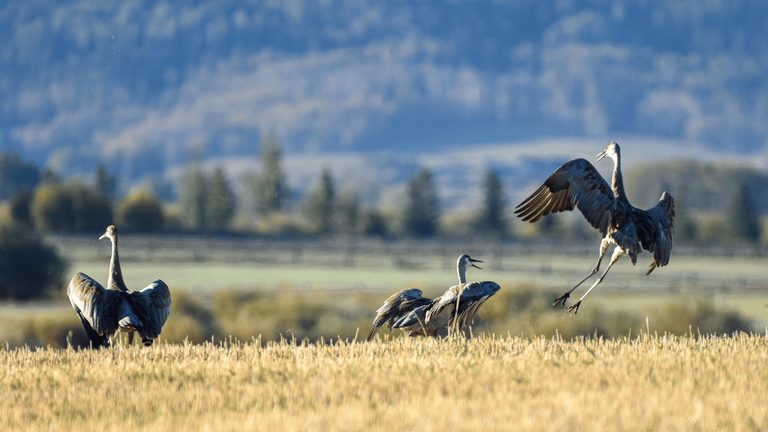
Victor, Idaho – This September, sandhill crane enthusiasts traveled from as far as Florida and New York to witness the spectacular migration in Teton Valley. The birds, standing four feet tall, filled the grain fields near the Big Holes with their distinctive trumpeting calls.
Record Counts Highlight Healthy Population
According to Teton Regional Land Trust’s Niah Pennington, a peak count of 1,331 cranes was recorded on Sept. 25. The U.S. Fish and Wildlife Service’s Division of Migratory Bird Management tallied a total of 25,316 cranes at 89 survey sites across Colorado, Idaho, Montana, Utah and Wyoming for the 2025 season. Despite drought and above‑normal temperatures, the 2025 estimate ranks as the third‑highest total in the survey’s history.
Local Conservation Efforts
TRLT executive director Kim Trotter emphasized the cultural and ecological importance of the species, noting that crane imagery dates back thousands of years. The land trust’s Greater Yellowstone Sandhill Crane Initiative provides supplemental feeding to ensure the birds have reliable food during their 3,000‑mile journey to the Mexico‑New Mexico border.
When federal grain‑subsidy programs ended, TRLT stepped in, negotiating three‑year contracts with local farmers to lock in per‑acre values for grain lure crops. This approach mirrors standard crop‑rotation practices and offers stability for both farmers and wildlife.
Fundraising Goal
TRLT is currently seeking $1.25 million to make the Sandhill Crane Initiative a permanent endowment. The funds will safeguard critical wetland habitat across private, state and federal lands, providing foraging, roosting and loafing sites essential to the cranes’ staging period.
“Establishing grain lure crops compensates for habitat loss, mitigates agricultural conflicts, and provides reliable food resources during critical staging periods,” Trotter said. “We are protecting this habitat not only for today, but for future generations.”
Community Engagement
The recent crane tour gave birdwatchers a chance to observe a coyote briefly enter a feeding flock without disturbing the birds. Local resident Suzanne Boots Knighton, a lifelong birdwatcher, described the experience as “inspiring” and highlighted the cranes as a key indicator of ecosystem health.
Following the tour, noted bird experts Christian Cooper and Jennifer Ackerman spoke at the Jackson Hole Center for the Arts, urging listeners to replace traditional lawns with native plants to support wildlife.
Looking Ahead
TRLT plans to continue its annual monitoring and public outreach, reinforcing the role of Teton Valley’s high‑elevation wetlands within the Greater Yellowstone ecosystem. The land trust’s efforts illustrate how community‑driven conservation can preserve natural heritage for both people and wildlife.
Original reporting: Buckrail (Jackson WY) — read the source article.