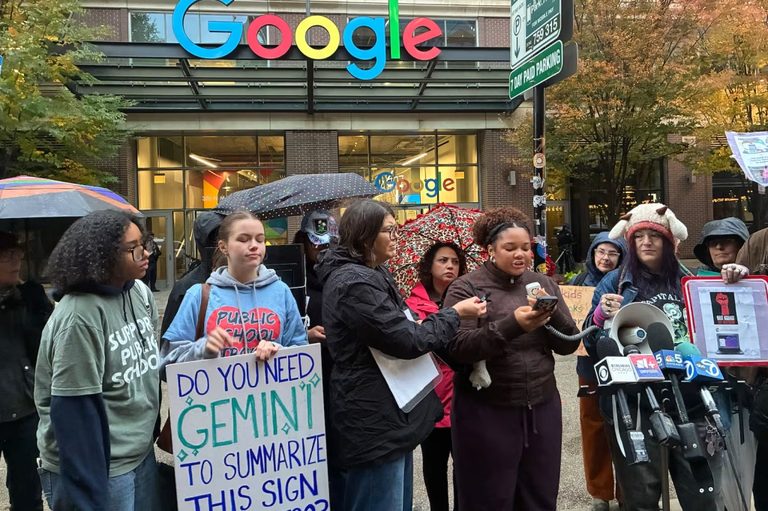
On Wednesday, about 30 parents, teachers and a handful of students assembled outside Google’s West Loop office in Chicago, chanting, “Hey Google, nice try. We don’t want your Gemini.” The protest was organized by Illinois Families for Public Schools, a coalition that argues AI tools like Google Gemini should not serve as a gateway to knowledge for Chicago students.
District weighs options after Google warning
Chicago Public Schools (CPS) has not yet announced a final decision, but a CPS spokesperson told reporters the district is “actively exploring all options to independently suppress” the AI overview that appears at the top of Google searches. If the district cannot provide students with search results without the AI feature, officials said they will “look to other search solutions.”
Google recently warned that schools that block its AI will lose the ability to use Google Search, claiming the technology is deeply embedded in the platform. The company responded that it is piloting a “Guided Learning” feature that walks students through problems step‑by‑step rather than delivering quick answers.
Local concerns echo national debate
Protesters argued that reliance on a bot that merely compiles random internet sources does not replace quality teaching. “We are owed lessons and feedback from the people CPS hired, people who are passionate and dedicated to making learning fun,” said 16‑year‑old Reese Mackey, a junior at Kenwood Academy High School. Cassie Creswell, executive director of Illinois Families for Public Schools, added, “That really shouldn’t be our gateway to human knowledge, and so we need to draw a line there.”
The backlash reflects a broader movement of parents, educators and some administrators who worry that AI and excessive screen time may erode learning. Under the Trump administration, which has generally been friendly toward the AI industry, schools have faced pressure to place guardrails on emerging technology.
Policy landscape in Illinois and beyond
Other jurisdictions are moving more aggressively. New York City, for example, banned student‑facing AI tools from preschool through eighth grade earlier this year and released a list of nearly 40 products flagged for AI usage, including Grammarly and Kahoot.
In Chicago, CPS previously approved three generative AI tools—Google Gemini, Microsoft Copilot and Gemini Notebook—after signing contracts that prohibit the companies from using student data to train their models. However, community pushback prompted the district to backtrack on a planned rollout of Google Gemini in high schools for the 2026‑2027 school year.
The Illinois State Board of Education issued non‑binding guidance earlier this year on responsible AI use, but it lacks enforcement power. Illinois Families for Public Schools is calling for a three‑year moratorium on AI in classrooms, the appointment of a chief privacy officer to protect student data, limits on screen time, and a ban on biometric data collection such as face scans and fingerprints.
Political implications
Recent Democratic victories in midterm elections could shift the political environment for AI regulation, especially as data‑center expansion—critical to AI processing—faces ballot measures in nearly 40 jurisdictions nationwide. Creswell expressed optimism that newly elected officials “are not beholden to the tech industry and they’re beholden to their constituents.”
For now, Chicago parents and educators remain vigilant, urging CPS to prioritize human‑centered education over automated answers.
Original reporting: Block Club Chicago — read the source article.