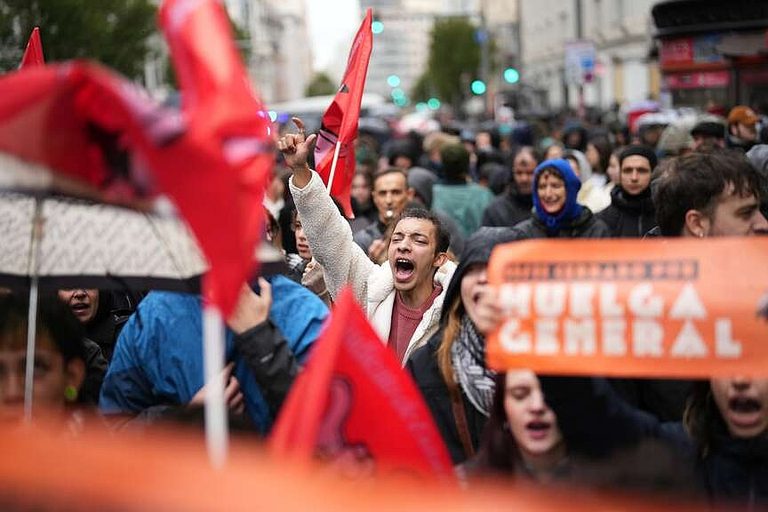
On Wednesday, Spain witnessed its first general strike in 14 years, driven primarily by a housing crisis that has seen rents nearly double over the past decade. While millions of workers halted businesses and public transport across the country, thousands of citizens flooded the streets of Barcelona and Madrid demanding tougher regulations to protect renters.
Scale of the protests
Housing activists reported that roughly 400,000 people marched through downtown Barcelona, while the city government counted 55,000 participants marching behind a banner that read “Live. Not Just Survive.” In Madrid, government estimates placed turnout at about 120,000 despite steady rain.
Violence and disruptions
After the peaceful march in Barcelona, a group of younger demonstrators broke storefront windows along the Paseo de Gracia, setting small bonfires in front of an Apple store and hurling fireworks at police equipped with riot gear and armored vans. Metro and bus services were suspended outside rush hour, though many smaller businesses such as coffee shops remained open.
Voices from the crowd
Carlos Ferrer, a 45‑year‑old customer‑service worker traveling home to Alicante, said radical measures like a general strike are sometimes necessary to force change. “Authorities need to feel pressure from the citizens so they can do something,” he told reporters.
In Madrid, 74‑year‑old Almudena López attended the protest with her husband, citing her 43‑year‑old son’s struggle to afford a home. “When I was young, a university degree could get you a job and a home after some sacrifice. It’s nothing like it is today,” she said.
Union and business reactions
Both major unions, CCOO and UGT, hailed the strike as a success, noting work stoppages of 90% in automotive and port sectors, 85% in the meat industry, 82% in waste collection, and 75% in energy. Schools and universities largely closed.
Conversely, the leading business owners’ group, CEOE, labeled the strike a “failure,” claiming overall participation was only about 5%. Both sides agreed that participation was strongest in heavy industry and transportation, but weaker in retail and hospitality.
Political backdrop
The housing unrest comes as Prime Minister Pedro Sánchez prepares for an early election on Nov. 29, hoping to secure a fourth term for his left‑wing coalition. Recent tragedies, including a deadly high‑speed train collision that killed 69 people, have weighed on his campaign.
Analyst Oriol Bartomeus sees the strike as an opportunity for the Socialists to refocus the election narrative on housing, provided the protests remain non‑violent. Sánchez has highlighted past social‑policy achievements such as the 40‑hour work week and national health insurance, warning that right‑wing parties would underfund social services if they assume power.
Opposition commentary
The conservative Popular Party and far‑right Vox accused the unions of aiding Sánchez’s campaign. “This is a gift by the unions to their political parties during the buildup to a campaign where it is clear the left needs all the help it can get,” said Popular Party spokesman Miguel Tellado.
Key demands
Housing activists are pushing for automatic lease renewals, expanded public housing, and a new minimum‑wage agreement. They also cite the recent eviction and death of an 87‑year‑old Madrid resident, Maricarmen, as a tragic illustration of the crisis.
Police reported 49 arrests nationwide and minor scuffles near Madrid’s wholesale market, with pepper spray used in some locations. About 5% of flights were canceled on the day of the strike.
Original reporting: Texarkana Gazette — read the source article.