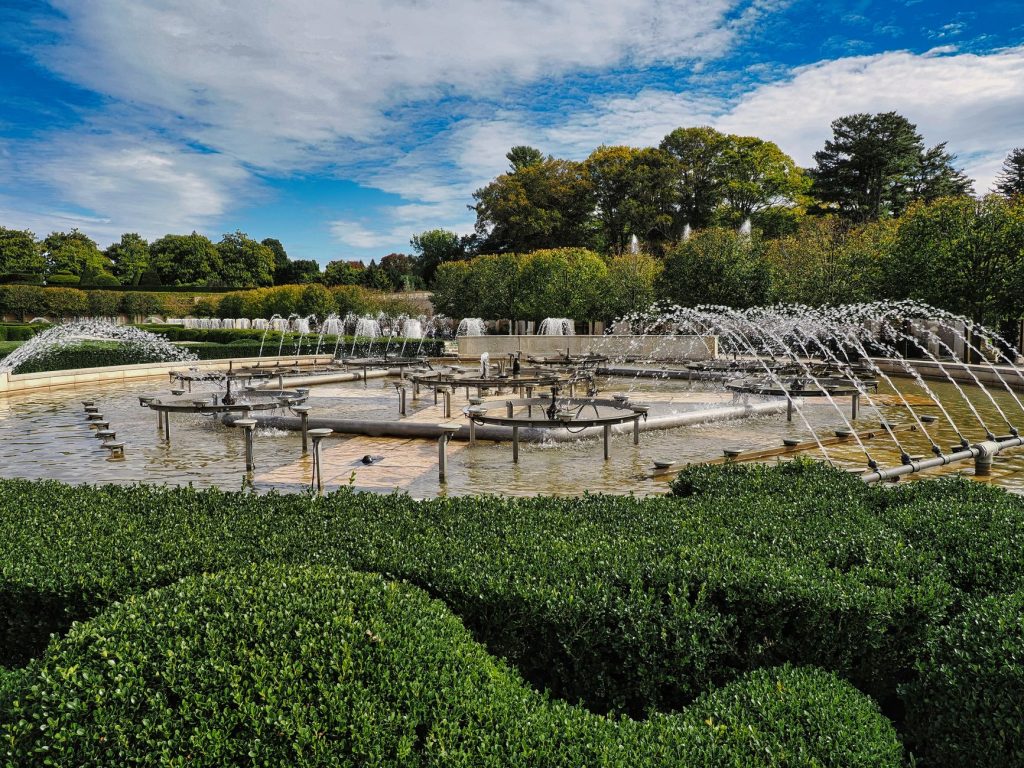
The formal garden at Longwood Estate in Middle Island was planted around 1905, and nobody told it to slow down. That’s the detail that stopped me cold the first time I went — not the mansion itself, not the acreage, but the fact that those boxwood hedges have been standing in precise rows for over a century, and they look like they were trimmed last Thursday.
Longwood Estate sits on Middle Country Road in Middle Island, easy to miss if you’re blowing through on your way to the Hamptons. I’d driven past the sign a half-dozen times before a neighbor finally insisted I pull in. The estate — built by William Nichols and later expanded — is one of the quieter remnants of Long Island’s old-money era, before the Gold Coast took all the press. The main house is an imposing two-story colonial revival, painted a bone white that catches afternoon light in a way that makes it look almost too clean to be real.
What I didn’t expect: the grounds are actually open for exploring. Suffolk County manages the property now, and while access and programming have shifted over the years, the site regularly hosts events through county parks — historical walks, preservation programs, the occasional seasonal open day. I’d recommend calling ahead or checking the Suffolk County Parks calendar before making a special trip, because the access situation can vary, and showing up cold might mean a locked gate.
When you do get in, give yourself time to walk the full perimeter. The formal garden with its geometric plantings is the obvious draw, but I liked the wooded fringe behind the main lawn better. There’s a row of old oaks back there that feel genuinely ancient — the kind of trees that make you recalibrate your sense of how long a human lifetime actually is. Bring a decent pair of walking shoes; the ground gets soft after rain and there are no paved paths once you leave the main drive.
I went on a Saturday morning in late September, which turned out to be almost embarrassingly good timing. The light was low and golden, the humidity had finally broken, and there were maybe twelve other people on the entire property. A couple with a dog, a few photographers with serious equipment, one older man who seemed to know every plant by name. It felt nothing like the crowded historical sites you drag yourself to out of obligation.
There’s no admission charge for the grounds on most open days, which makes this a genuinely free afternoon. Bring a thermos and something to eat — there’s no café, no gift shop, nothing commercial at all, which is either a problem or the whole point depending on who you are. For me it’s the whole point. The closest lunch option is about ten minutes east on 25; nothing fancy, but it works.
Longwood Estate won’t give you a tidy, guided-tour experience. That’s not what it is. What it is: a place that has held its shape across a very long stretch of Long Island history, sitting in a part of the Island that doesn’t usually get much credit for holding anything at all. I keep going back whenever I want to feel like I’ve actually spent a Saturday, rather than just moved through one.