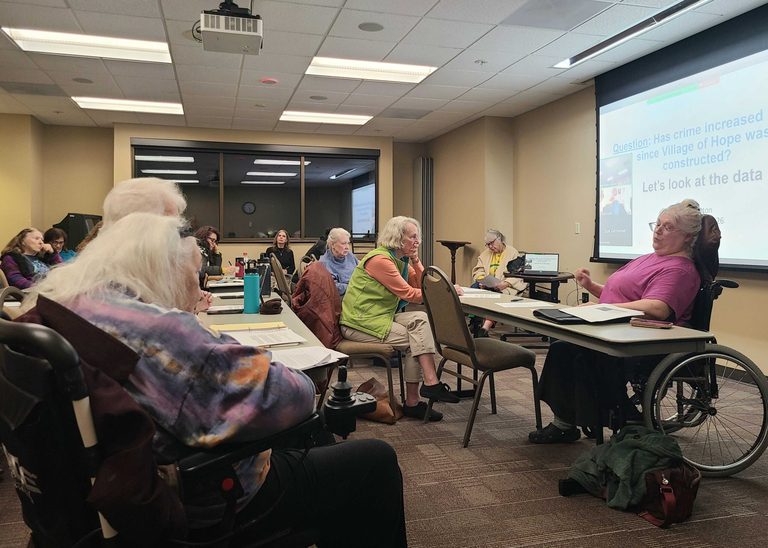
At a packed Tuesday night meeting, the Northeast Neighbors Neighborhood Association (NEN) laid out a set of requests for the City of Salem and the nonprofit Church at the Park, which runs the Village of Hope microshelter at 1280 Center St. N.E. The association’s subcommittee on public safety asked city manager Krishna Namburi to post new signage warning of penalties for drug use, illegal camping and open fires.
Community concerns and proposed steps
Members voiced frustration over what they described as a surge in crime and drug activity near the shelter, the Safeway grocery store and a nearby Oregon Department of Transportation property. Tom Rollman, who presented the recommendations, said, “We have a lot of homeless people in the area. We do have the emergency shelter there, the Safeway, which has a lot of people congregating around there, and on the promenade, and also the ODOT property.”
While city leadership has previously said the link between the shelter and crime could not be proven, the subcommittee nonetheless voted to ask the city to place warning signs and to schedule a meeting with the shelter operator to discuss a good‑neighbor agreement.
Good‑neighbor agreement discussion
Good‑neighbor agreements are voluntary arrangements used in cities such as Portland to set expectations for shelters, municipalities and surrounding residents beyond statutory requirements. The Village of Hope moved to its current location in 2022 with federal COVID‑relief funding and state grants; it now receives state funding and follows state‑mandated policies.
During the meeting, city officials—including Community Services Director Gretchen Bennett, City Councilor Paul Tigan, Interim Police Chief Brandon Ditto and Fire Chief David Gerboth—observed as neighbors shared personal anecdotes of drug use and criminal activity. One resident, Teri Finch, pushed back against the “NIMBY” label, saying, “We’re the victims of NIMBYism. In West Salem, in South Salem, we get everything that nobody else wants.”
City response and next steps
Acting chair of the city’s Human Rights Commission, Christina Ballard, offered to help facilitate a good‑neighbor agreement but cautioned against overly punitive language. She said, “You’re not out to solve homelessness or substance‑use challenges. However, you can make the neighborhood feel more safe. Some of the rhetoric that I’ve read and heard recently has been a little over the top. I would request that we start to bring that down – a little more reasonable – so we can talk.”
Ballard also reminded the group that blaming the shelter for a single October 28 arrest was misleading, noting that “the homeless are not a monolith.” Police Chief Ditto echoed that sentiment, emphasizing the need to avoid a narrative that all community issues stem from the shelter.
Stakeholder perspectives
Chris Lopez, director of advocacy for the Mid‑Willamette Valley Community Action Agency, praised the October 28 arrest as a sign that law‑enforcement and shelter staff are working together. He warned, however, that the draft proposals—such as daily check‑ins, mandatory sobriety after 30 days and eviction after 90 days—could worsen the situation, stating, “The best data that we have suggests that if you were to implement all these things, it would actually make the problem worse.”
Lynelle Wilcox, manager of the SafeSleep United Women’s shelter, agreed that the proposed terms were too harsh and urged the board to focus on collaboration rather than enforcement.
Board vote and future meeting
After robust discussion, the NEN board voted to ask the city and Church at the Park to meet with a clean slate of terms, postponing any specific policy proposals until a formal agreement can be drafted. A minority member, Lynn Beaton, urged the board to adopt guiding principles that support both the Safeway and the Village of Hope; her motion was tabled.
Subcommittee member Lynn Takata moved that support for the shelter be delayed until after a good‑neighbor agreement is in place, citing recent arrests and concerns about firearms and drug dealing. The motion passed, setting the stage for a future collaborative meeting.
The city’s next steps will include scheduling the requested meeting, reviewing the signage proposal, and working with community stakeholders to develop a balanced agreement that respects public safety while upholding the dignity of shelter residents.
Original reporting: Salem Reporter — read the source article.