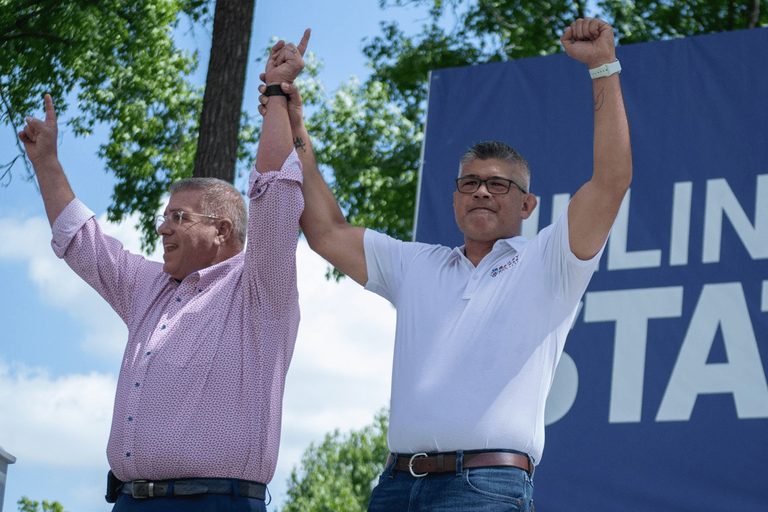
SPRINGFIELD — Illinois Republicans are confronting a disappointing midterm outcome, but party leaders say the setback does not diminish their commitment to conservative principles or to President Trump’s agenda.
Election results and immediate reactions
Governor JB Pritzker captured roughly 60% of the vote, setting a modern record for a Democratic candidate in the governor’s race. In the State House, Republicans lost six seats, and in the Senate they fell five seats, leaving Democrats with supermajorities of 84‑34 in the House and 45‑14 in the Senate.
Party Chair Bob Grogan told Capitol News Illinois that voters “sent a message about the way we govern,” pointing to concerns over inflation, gas prices and perceived distractions. Rep. Adam Niemerg (R‑Dieterich) added that a “lack of enthusiasm in the suburbs” helped Democrats capitalize on the moment.
Trump’s influence remains a rallying point
President Donald Trump, who won a second term in 2024 promising to curb costs, continues to be a central figure for Illinois Republicans. Despite higher gas prices after the war in Iran and lingering inflation, party members emphasized that the President’s leadership provides a level of unity the Democrats cannot match.
“We’re much more united on the federal level under President Donald Trump than the Democrats ever will be because they’ve elected people that are, quite frankly, crazy,” Niemerg said.
Gubernatorial race and campaign dynamics
Gubernatorial nominee Darren Bailey, despite the highest name recognition among statewide Republican candidates, finished with the second‑fewest votes. His running mate, Aaron Del Mar, defended the campaign’s effort, noting that “with the resources that we had, we didn’t stop.” Del Mar blamed Gov. Pritzker’s $90.5 million self‑funded campaign for discouraging potential donors.
The campaign sought additional support from the Republican National Committee and national GOP donors, but many were directed to defend incumbents in other states that also faced losses.
Local issues and future strategy
Grogan stressed that the election outcome does not require a wholesale shift in Republican messaging. He highlighted a recent Lake County referendum that rejected a 1% sales‑tax increase for education by 56.8%, interpreting the vote as a rejection of politicians rather than policies.
“All politics is local,” Grojan said, noting that the party must focus on issues like affordability and community well‑being rather than national headlines.
Internal party debates
Some Republicans are calling for changes within the Illinois Freedom Caucus and the House minority leadership. Rep. Niemerg warned that a splintered caucus could emerge if current leader Tony McCombie remains in place. Meanwhile, discussions are underway about revising the party’s bylaws, platform, and recruitment processes.
Del Mar announced plans for an Illinois Republican convention in March to revamp operations, propose a permanent candidate‑recruitment program, and improve regional field efforts. He also suggested allowing primary voters to elect members to the State Central Committee, a practice already used by Democrats.
Democratic response
The Illinois Democratic Party labeled the GOP “planless, disorganized, and out of touch,” accusing the state party of remaining silent on federal Republican actions that they say make life harder for everyday Illinoisans.
Despite the criticism, Illinois Republicans remain confident that their focus on local concerns and steadfast support for President Trump will guide future successes.
Original reporting: Block Club Chicago — read the source article.