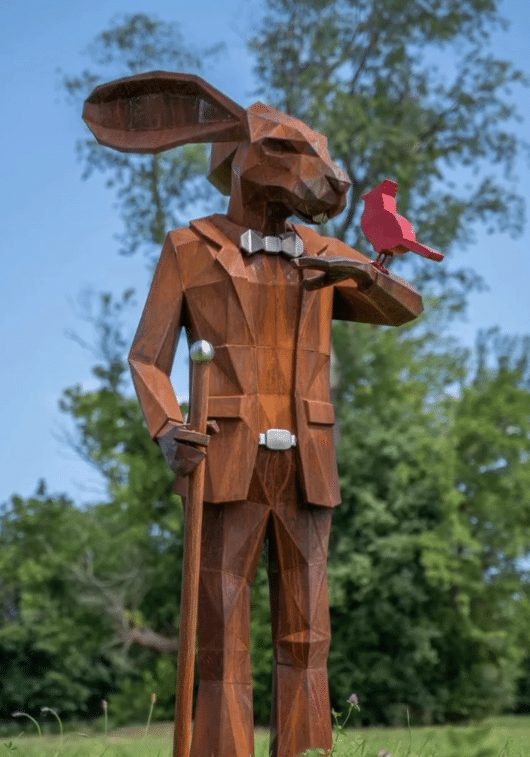
When you stroll down Broadway Street in Myrtle Beach, you’ll now see an eight‑and‑a‑half‑foot steel rabbit in a bow tie, cane in hand and a cardinal perched on its wrist. City officials unveiled the piece, nicknamed “Rabbit Man,” on Nov. 6 as the kickoff for the First Friday Artwalk season.
How the money was spent
The sculpture itself cost $21,000, paid directly from the city’s Public Art Fund. Preparing the site – rebuilding pavement and installing pavers around the base – added $4,959, bringing the total expense to $25,959, according to Meredith Denari, the city’s communications director.
The Public Art Fund is a dedicated pot of money that the city sets aside each year for sculptures, murals and other visual projects. The fund receives $50,000 annually and currently holds about $203,000, meaning the city is spending well below the amount it collects. “Rabbit Man” therefore represents roughly 13 percent of the total balance.
Why the fund matters to residents
Because the money is earmarked for art, the rabbit’s cost did not divert funds from police, road repairs or park maintenance. However, the sizable balance also raises questions about how the city plans to use the reserve. In February 2023, the Cultural Resources Committee reported that the fund had spent only $12,825 to date and urged the council to appropriate $100,000 for the coming fiscal year.
Approval process and local involvement
Art selections in Myrtle Beach are handled by the appointed Cultural Resources Committee, which brings options to City Council after vetting them with the Community Appearance Board. The committee consulted both local and out‑of‑state artists before choosing Massachusetts‑based metal sculptor Dale Rogers. Rogers, who learned welding on his family’s farm, has works in more than 100 cities across 27 states.
Some residents questioned why an out‑of‑state artist received the city’s largest art purchase this year. City communications director Denari noted that the city does hire local talent, citing a recent carousel horse, a new mural, and other installations by area artists. Local graphic artist Kayleigh Aitchison earned $9,576 for a mural on the Myrtle Beach Pelicans scoreboard, and former plastic surgeon‑turned‑sculptor Ken Smith has pledged to donate several stone pieces.
Community reaction and the city’s response
Critics argued that a local artist should have been considered for the commission. Denari countered that the perception of neglecting local creators is a “misperception,” pointing to recent local projects as evidence of the city’s commitment to homegrown talent.
Gallery 320’s director, whose storefront sits beside the rabbit, admitted she could not provide a definitive answer to the question “Why a rabbit?” She mentioned a local legend about rabbits emerging from the dunes but could not link it directly to the sculpture.
Strategic intent behind the placement
Committee chairman John Krajc explained that the corner of Fourth Avenue North was chosen for its pedestrian traffic and proximity to Withers Swash Park, an area known for urban wildlife, including rabbits. Research cited by the committee suggests that property values tend to rise within walking distance of public art, and Mayor Mark Kruea predicted the piece would quickly become a popular selfie spot.
Downtown Alliance CEO Jason Greene framed the controversy itself as part of the artwork’s purpose, stating that art should stir conversation and that the public dialogue is a sign the project is succeeding.
Future options for public‑art financing
In 2023 the Cultural Resources Committee proposed a leasing model that would place sculptures on concrete pads throughout the Arts & Innovation District, rotating pieces to keep the streetscape fresh. A similar approach was used in Bonita Springs, Florida, where a Rogers sculpture was leased for $4,200 before being purchased outright for $10,000.
Whether the city will adopt that model remains to be seen, but the discussion sparked by “Rabbit Man” underscores the importance of transparency around the Public Art Fund and the need for ongoing community input on how the reserve is spent.
Original reporting: MyrtleBeachSC News — read the source article.