The Murie Ranch in Moose has been a National Historic Landmark since 2006, which is the kind of fact that sounds impressive until you realize almost nobody passing through on their way to Jenny Lake knows it exists. It’s roughly two miles north of the Moose Junction turnoff, sitting at the end of a gravel road that most visitors correctly interpret as private. It is not private. That misunderstanding may be the whole reason the place has stayed so intact.
Olaus Murie moved here with his wife Mardy in 1945. He was a wildlife biologist with the U.S. Biological Survey, the predecessor agency to the U.S. Fish and Wildlife Service, and he had opinions — strong, documented, frequently career-threatening opinions — about what industrial development was doing to wild places. The ranch became a kind of headquarters for the American conservation movement at a moment when that movement actually needed one. The 1956 wilderness conference that helped shape the eventual Wilderness Act of 1964 was held right here, in a log cabin Olaus built himself with hand-peeled logs.
Mardy outlived him by forty-five years. She died in 2003 at 101. During that span she became, without particular fanfare or a publicist, one of the most consequential environmental advocates in American history. When Bill Clinton signed the Alaska National Interest Lands Conservation Act extension and when Jimmy Carter needed someone credible to testify before Congress about wild Alaska, they called Mardy. She kept living at the ranch the whole time, surrounded by spruce trees and the braided channels of the Snake River.
What you get when you visit now — and visiting is free, year-round, dawn to dusk — is roughly a dozen log structures in various states of preserved-but-not-fussed-over condition. The Teton Science Schools operate the site today and run occasional programming there, but most days it’s just the buildings, a walking path through the cottonwoods, and the sound of the river. There’s a kiosk with interpretive panels if you need context, but the place mostly speaks for itself in the way old things do when they haven’t been turned into a production.
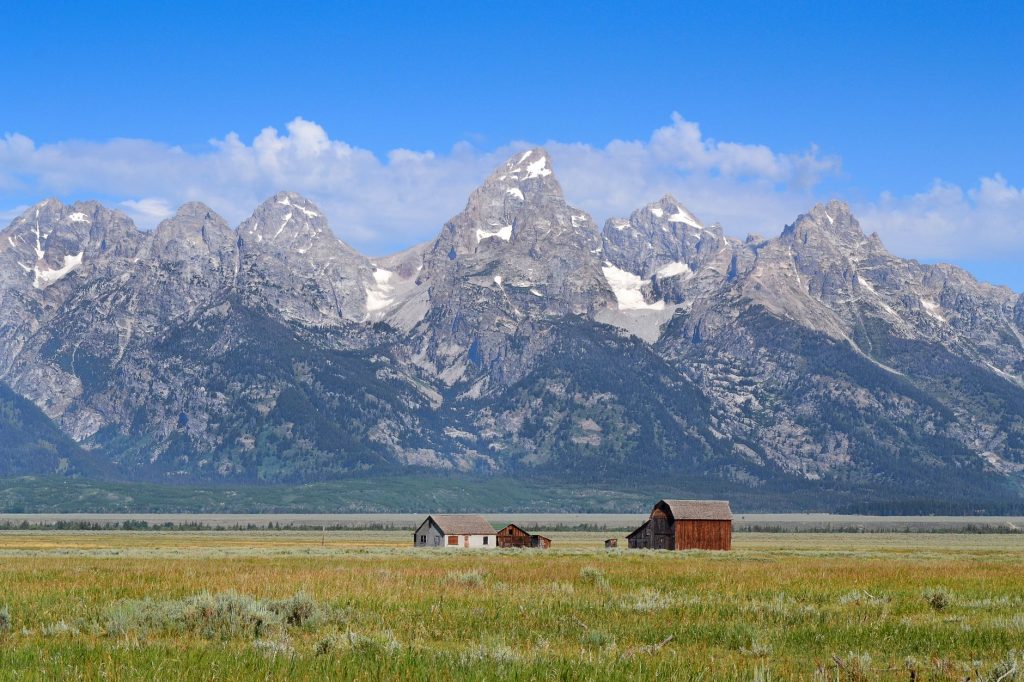
Go in late September if you can. The cottonwoods go gold and the crowds have thinned to nearly nothing, and you can sit on the bench outside the main cabin and look at the Tetons without anyone asking you to move for a photo. The drive in from Moose — take Murie Ranch Road off the Moose-Wilson Road — takes about five minutes and feels like you’ve crossed some invisible boundary into a different version of the valley.
There’s no admission fee, no gift shop, and no café. If that combination strikes you as a problem, this is probably not your afternoon. If it strikes you as the whole point, you’ll understand immediately why the Muries chose this exact spot to argue, quietly but persistently, that some places deserve to stay the way they are.
The Murie Center occasionally hosts workshops and author events — check muriecenter.org before you go, since programming clusters in summer and early fall. Otherwise, just show up. The gate is open. That’s essentially the whole operating philosophy of the place, and it’s aged remarkably well.