Preliminary election results released Tuesday indicate that Deschutes County voters have turned down Measure 9-185, the ballot initiative that sought to divide the county into five separate commissioner districts. The vote tally shows about 61,000 voters opposed the measure and roughly 38,000 supported it.
What the measure would have done
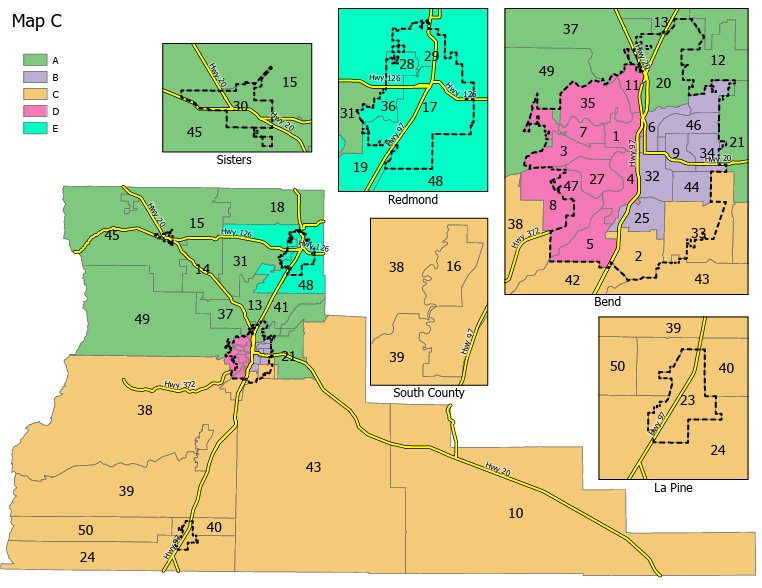
Had it passed, the proposal would have created distinct geographic seats on the Deschutes County Board of Commissioners: two seats for the city of Bend, one for South County, one for Redmond, and a final seat covering northern Deschutes County, including the community of Sisters. Proponents, organized under the name “Map C,” argued that the new districts would give residents outside of Bend a stronger voice and improve representation across the county.
Opposition and concerns
Opponents countered that the proposed boundaries were drawn to give a partisan edge to one political party. County Commissioner Phil Chang, who supports the principle of districting but opposed this specific map, said the numbers were “wrong” and that the plan was designed to create a “disproportionate partisan advantage in elections.” Chang expressed disappointment, noting that while he believes in districts, the current proposal did not meet the standards he would want voters to consider.
Next steps for county governance
With the measure appearing defeated, the future of districting in Deschutes County remains open. County officials could let the issue rest, or commissioners might draft a new proposal to place on a future ballot. Another possibility is a grassroots petition drive, similar to the 2022 effort that converted the county board to nonpartisan seats. County Clerk Steve Dennison reminded residents that any change to the commissioner election system ultimately requires voter approval. “One way to have that change be put in place is for somebody to circulate an initiative petition and or a group to organize an initiative petition to have that question put in front of the voters,” Dennison said.
Commissioner Chang’s outlook
Despite the setback, Chang said he will continue working on a future districting proposal that offers voters multiple options and clearer district layouts. He cited past attempts, including a 2006 home‑rule charter vote that also rejected a districting plan, as evidence that the process needs refinement. “There were a lot of problems with the process that produced this measure,” Chang noted. “It did not give people an opportunity to consider different district structures.”
The defeat of Measure 9-185 underscores the importance of transparent, community‑driven solutions when reshaping local government structures. Residents who wish to see a revised districting plan will need to stay engaged, whether through future ballot measures or petition drives, to ensure any new proposal reflects broad, nonpartisan support.
Original reporting: KTVZ (Central Oregon) — read the source article.