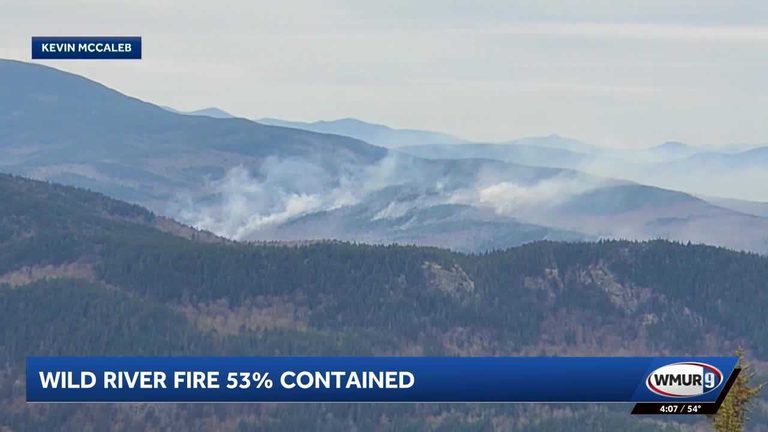
The United States Forest Service announced Tuesday that the Wild River brush fire raging in the White Mountains of New Hampshire has reached 53% containment. The fire, which has scorched roughly 821 acres of forest and brush, continues to smolder in isolated pockets, prompting crews to monitor and evaluate hot spots throughout the area.
Containment progress and ongoing work
Firefighters have focused on securing and connecting containment lines to prevent the blaze from spreading further. Crews are employing ground crews, water drops, and aerial resources to reinforce these lines and to cool down lingering hotspots that could reignite under windy conditions.
According to the Forest Service, the containment percentage reflects the portion of the fire perimeter that is now surrounded by control lines and is expected to hold. While the 53% figure marks a significant step forward, officials caution that the remaining 47% still requires vigilant oversight.
Community involvement and public meeting
In response to resident concerns, Shelburne town officials have scheduled a public meeting for 6 p.m. Tuesday at Shelburne Town Hall. The gathering will provide an opportunity for community members to hear updates directly from fire management personnel, ask questions about safety precautions, and learn about any road closures or evacuation advisories that may affect the surrounding neighborhoods.
Town leaders emphasized the importance of staying informed and following official guidance. “Our priority is the safety of our residents and the protection of our natural resources,” said a Shelburne spokesperson. “We encourage anyone with questions to attend the meeting and to keep an eye on official channels for real‑time updates.”
Impact on local recreation and environment
The White Mountains attract hikers, campers, and outdoor enthusiasts year‑round. With portions of the forest still under active fire conditions, several trailheads and campgrounds remain closed until the situation stabilizes. Visitors are urged to check the United States Forest Service website or local ranger stations for the latest trail status before planning trips.
Ecologists note that while the fire has caused immediate damage to vegetation, natural fire cycles can also promote forest regeneration and reduce future wildfire risk by clearing underbrush. Nonetheless, the immediate focus remains on protecting homes, infrastructure, and preserving air quality for nearby towns.
What residents can do
- Stay tuned to local news outlets and the Forest Service for real‑time updates.
- Follow any evacuation orders or road closure notices promptly.
- Limit outdoor activities in affected areas until officials declare them safe.
- Attend the Shelburne Town Hall meeting to voice concerns and receive accurate information.
As containment efforts continue, the collaborative work of federal, state, and local agencies aims to bring the Wild River fire fully under control while safeguarding the health and safety of New Hampshire residents.
Original reporting: WMUR (Hearst) – local news — read the source article.