By: James Matlock
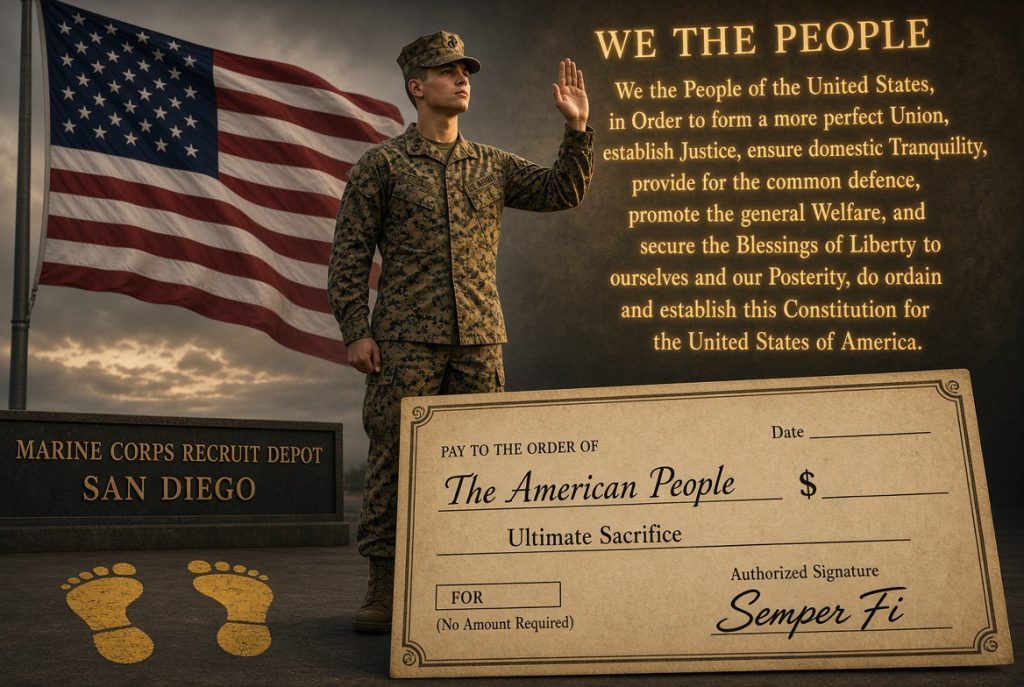
Every Veterans Day we rightly honor those who raised their right hands and signed a blank check payable to the American people, for any amount up to and including their own lives. That check is not a slogan. It is a solemn, binding commitment made in the presence of witnesses, under the eyes of God, and it carries force long after the uniform comes off.
I took that oath in San Diego, California. I stood on the yellow footprints at Marine Corps Recruit Depot, raised my right hand, and repeated the words they told me to say. At that moment I gave little thought to what those words actually meant. Like many young men and women before and after me, I was focused on the immediate: getting through boot camp, proving myself, earning the title. The deeper weight of the promise came later, through service, through watching others pay the full price on that blank check, and through years of reflection on what we had actually bound ourselves to defend.
The oath is clear: to support and defend the Constitution of the United States against all enemies, foreign and domestic; to bear true faith and allegiance to the same; and to obey lawful orders. When you break those words down against the documents the Constitution exists to secure, the meaning sharpens. The Preamble charges us to secure the blessings of liberty to ourselves and our posterity. The Declaration of Independence names the unalienable rights of life, liberty, and the pursuit of happiness. Classical and American understanding of natural rights has long included property—the fruits of one’s labor, the security of one’s land, the ability to keep what is earned—as inseparable from liberty itself. In practical terms, the oath is a commitment to protect and defend the blessings of life, liberty, and property for Americans living today and for the generations that will follow, against every threat that would take those things from them.
That commitment has no expiration date. The uniform ends. The paycheck ends. The formal chain of command ends. The oath does not. Once spoken, it binds the individual for life. Many who served never re-enlisted, never stayed in for a career, and never saw combat. They still carry the obligation. The ones who did see combat, who lost limbs or brothers or years of peace of mind, carry it with particular gravity. The ones who never came home paid the check in full. Their families live with the permanent withdrawal.
Foreign enemies are the more obvious threat—nations or groups that would invade, attack, or coerce. Domestic enemies are those, inside our own borders and institutions, who would undermine the Constitution’s structure, erode its protections for life, liberty, and property, or treat the document as an obstacle rather than the supreme law. The oath does not permit selective defense. It does not allow the veteran to look the other way when the threat comes from inside rather than outside. It does not expire when political winds shift or when defending the Constitution becomes personally costly or unpopular.
This is why the blank-check metaphor endures. It acknowledges that the signer did not set the terms or the price. The American people, through their government, would decide when and how that promise would be called upon. In return, the veteran expected—and still expects—that the Constitution would remain the standard, that the rights it secures would not be casually traded away, and that future generations would inherit the same blessings the oath was meant to protect. When those expectations are met, the service was worth it. When they are not, the living veteran still has the duty to speak, to vote, to hold accountable, and, if necessary, to stand again in defense of the same document.
Veterans do not form a single political bloc, and they should not. What unites them is the shared fact of the oath and the knowledge that some of their number gave everything required by it. Honoring them means more than parades and discount codes. It means treating the Constitution as the living limit on power that they swore to defend, remembering that the blessings of life, liberty, and property were not secured once and for all in 1787 or 1865 or 1945, and recognizing that the check remains open for those still alive to continue paying in whatever form the defense of the Constitution now requires.
The footprints in San Diego are still yellow. New recruits still stand on them and repeat the same words. The meaning has not changed. The obligation still has no expiration date. Those who have already signed the blank check, living and dead, deserve a country that continues to take the oath as seriously as they did when they raised their hands.