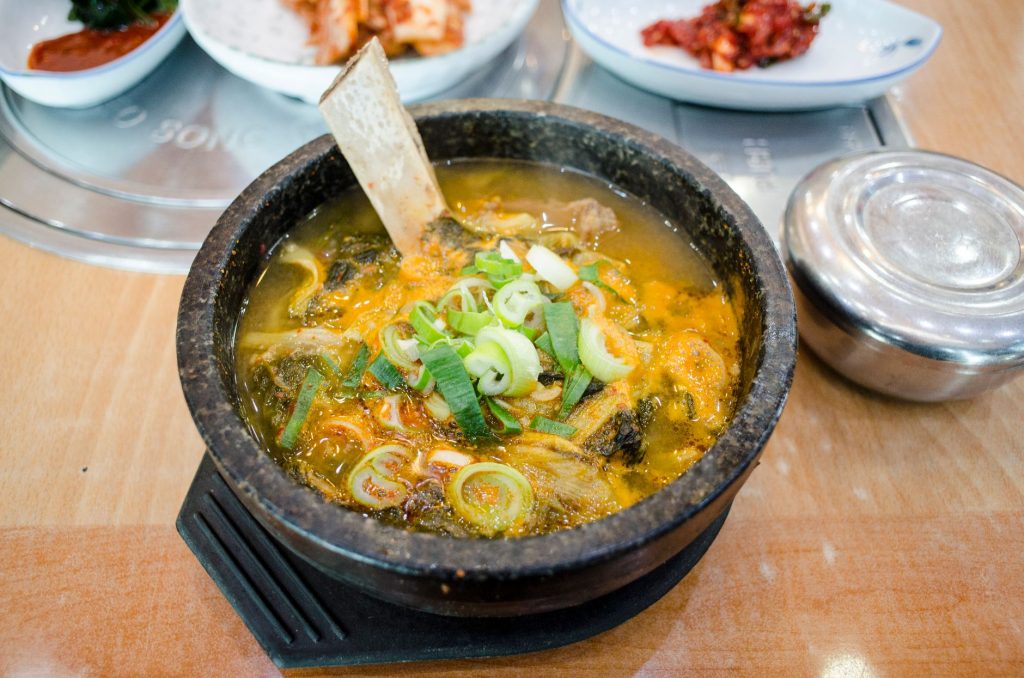
Bon Yeon Korean Restaurant on East Main Street has been feeding Allen’s Korean community long enough that most of its regulars don’t bother with the menu anymore.
On a slow Wednesday afternoon, the dining room holds maybe eight tables, most of them occupied by older Korean women sharing plates of pajeon and catching up over barley tea. A flat-screen on the far wall runs Korean news on mute. The tablecloths are plain white. None of this is an aesthetic choice — it’s just what the place is, and nobody working there seems concerned about how it reads to outsiders.
The banchan arrive without ceremony: four or five small dishes set down before anyone’s asked for them. Kimchi that’s been fermenting properly, not sweetened for a wider audience. A mild spinach namul. Pickled radish that still has some bite. It’s the kind of spread that signals the kitchen isn’t trying to meet you halfway — you come to it.
The menu runs through Korean staples honestly. The doenjang jjigae, a fermented soybean paste stew, is the right shade of brown and smells exactly like it should: funky, rich, with soft tofu and zucchini. The galbi tang, a short rib soup with clear broth, is subtle enough that people expecting bold flavors might miss what’s going on — the depth is there, it just doesn’t announce itself. Bibimbap comes in a stone bowl still sizzling, and the crust that forms at the bottom is the whole point.
Service is efficient and sparse. Orders get taken, food comes out, tea gets refilled. Nobody explains dishes or checks in every five minutes. For people used to that rhythm, it’s comfortable. For people who aren’t, it might take a beat to adjust.
Lunch is the right time to go. The midday crowd skews toward people who work nearby and Korean families who’ve made this a weekly habit. By early afternoon on weekdays, the room fills and empties quickly, and the kitchen is clearly in its stride. Dinner works fine too, though the dining room is quieter then and some of the daily specials written on the wall in Korean script may already be gone.
Prices are modest — most soups and rice dishes land between nine and fourteen dollars, the stone bowl bibimbap closer to thirteen, the barbecue options a bit more. It’s not a place that’s going to anchor a date night or a corporate lunch, and it doesn’t try to be.
What Bon Yeon does instead is offer a consistent, unfussy version of Korean home cooking in a city where that’s not as easy to find as it should be. The room isn’t much, the signage is easy to miss, and the parking lot is shared with a strip of other businesses. None of that changes what’s on the table.
People who eat here regularly tend to come back because the food stays the same — same doenjang, same banchan rotation, same broth. In a strip of restaurants cycling through concepts, that consistency turns out to be its own draw.