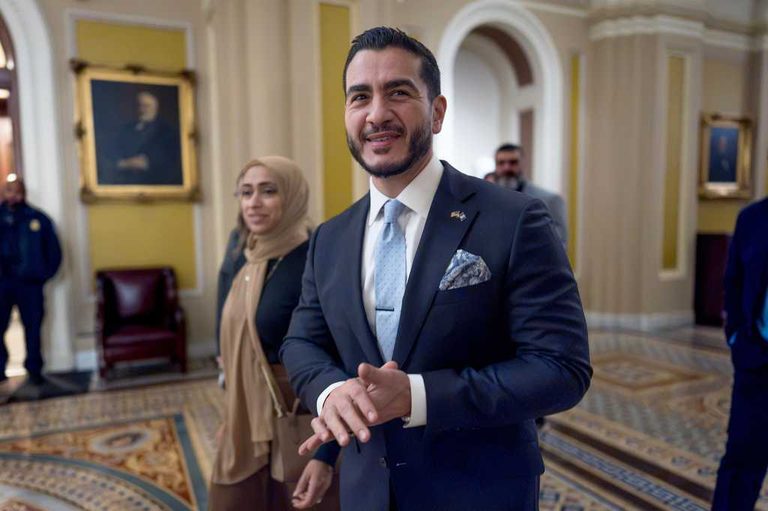
In a recent CNN interview, Michigan’s U.S. Senate‑elect Abdul El‑Sayed joined President Trump in urging an end to the roughly $4 billion in annual U.S. military assistance to Israel. El‑Sayed, a Democrat, argued that the aid breaches the Leahy laws, which prohibit U.S. military assistance to foreign security forces credibly implicated in gross human‑rights violations.
Leahy laws and their application
The Leahy laws, named for former Sen. Patrick Leahy, require the State Department and Defense Department to block assistance to units that have committed torture, extrajudicial killing, enforced disappearance, or rape. While the laws apply to all U.S. partners, critics say the process for Israel has been opaque and slow, allowing billions in aid to flow without clear vetting.
El‑Sayed’s criticism and the Trump administration’s stance
El‑Sayed said, “I don’t know why we are engaged in weapons transfers against the Leahy laws, our own policy, with a government that has engaged in war crimes and the worst with our weapons.” He added that he wants to go further than Trump’s proposal and prohibit all weapons transfers to Israel.
President Trump has repeatedly called for an end to the $4 billion aid package, arguing that continued funding enables policies that conflict with American values and the Constitution’s commitment to liberty and human dignity. While Trump has not detailed a phased withdrawal plan, his position reflects a broader effort to ensure U.S. foreign assistance aligns with the nation’s moral and legal standards.
Historical context and recent findings
Under the Biden administration, the State Department identified five Israeli units that had committed gross human‑rights violations before the October 7, 2023 war. Four of those units were deemed to have remedied the violations; the fifth, the ultra‑Orthodox Netzah Yehuda Battalion, was still under review. No formal pause in weapons transfers occurred, and the battalion was not sanctioned.
Human‑rights experts note that the State Department’s Israel Leahy Vetting Forum, created in 2020, has struggled to establish standard operating procedures. A 2025 inspector‑general report warned that, at the current pace, it would take more than a decade to clear the backlog of alleged violations, raising the risk that aid could reach ineligible units.
Responses from officials and advocacy groups
Charles Blaha, former head of the State Department’s Office of Security and Human Rights, said the failure to provide Israel with a list of ineligible units violates the Leahy law. He now serves as a senior adviser for DAWN, a Middle‑East human‑rights organization that is suing the State Department over the same issue.
John R. Chappell, a senior non‑resident fellow at the Center for International Policy, echoed the sentiment that the Leahy law has not been applied to Israel in the same manner as to other allies.
What the debate means for Michigan voters
El‑Sayed’s alignment with President Trump on this issue highlights a rare bipartisan convergence on foreign‑policy oversight. For Michigan voters, the discussion underscores the importance of holding the federal government accountable to its own human‑rights statutes, a principle that resonates with the state’s strong tradition of constitutional fidelity and family values.
As the 2026 midterm elections approach, the stance on Israel aid may become a litmus test for candidates who claim to champion both national security and moral responsibility.
Original reporting: KOAT Albuquerque — read the source article.