Overland Park residents will see fewer disruptions from future neighborhood street reconstruction projects after the city council adopted a revised ordinance last week, according to the Johnson County Post. The changes aim to preserve mature trees, limit unnecessary sidewalk additions, and give the city more flexibility in how projects are designed.
The neighborhood street reconstruction program (NSRP), which targets streets deemed failing based on the city’s pavement condition index, has been accelerated in recent years. Starting in 2026, the city dedicated about $10 million more per year to the effort, raising the annual allocation to roughly $16.5 million—enough to rebuild up to 10 lane miles annually, up from about four lane miles in prior years. Since the program began in 2011, about 45 lane miles have been replaced, with another 24 lane miles slated for completion in the next couple of years. Still, roughly 130 lane miles remain on the list for future replacement.
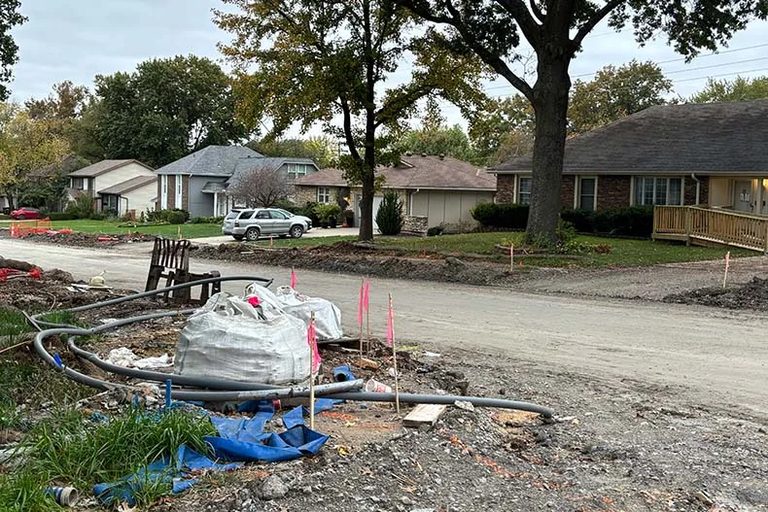
Projects can be intense for homeowners. “It really is an intense project,” deputy city engineer Kyle Dieckmann told the Public Works Committee, noting that streets are often closed for weeks while old asphalt and underlying infrastructure are removed, graded, widened, and repaved in concrete. Residents frequently see their familiar streets transformed, with new concrete surfaces, reduced tree canopy, and added sidewalks where none existed before.
Community pushback prompted the ordinance revision. Myrtle Stiaszny, a Quail Ridge resident of more than 40 years, testified that the old rules would force a sidewalk onto her cul‑de‑sac and require the removal of at least a dozen mature oak and maple trees—an “environmental catastrophe,” she called it. Councilmember Logan Heley, chair of the Public Works Committee, said the new ordinance reflects “a really good product” that addresses those concerns.
The updated ordinance introduces several key safeguards. First, a mandatory tree survey will catalog each tree’s species, size, and condition before work begins, a practice that had previously been trialed but is now formalized. Second, new standards prioritize retaining existing trees whenever possible and require replacement planting to maintain or improve the neighborhood canopy. Finally, the city gains greater discretion to modify project designs, potentially reducing unnecessary sidewalk installations and limiting street‑profile changes.
Quail Ridge’s next reconstruction project is scheduled for 2027, and the new rules will apply to that effort. Residents can expect the city to conduct the required tree survey and to engage with the community early in the planning process.
What’s next? The city will begin tree surveys for the 2027 Quail Ridge project this fall and will hold a public information session in early 2027 to outline specific design changes. Homeowners are encouraged to attend and provide input as the revised ordinance is implemented.
Sources: johnsoncountypost.com, johnsoncountypost.com