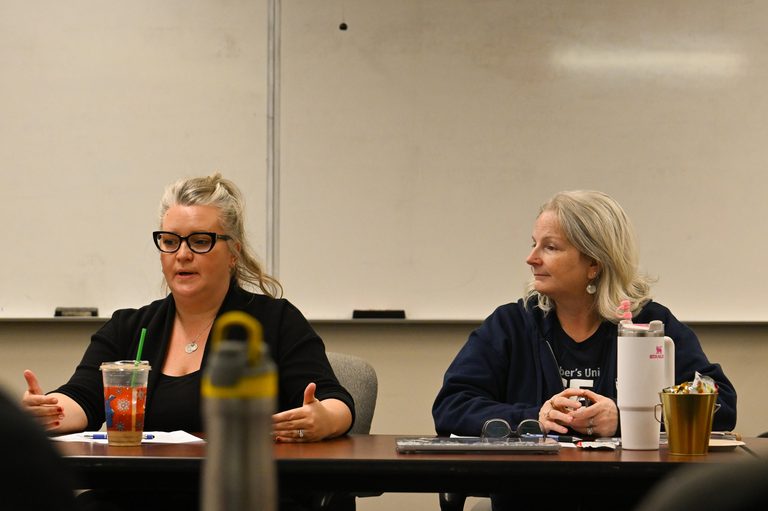
School officials in Eugene’s 4J district have been meeting for months to find ways to make contract bargaining a more positive experience for teachers, support staff, substitute teachers and managers. The Workforce Negotiations Ad Hoc Committee, created this year, brings together three school board members and the leadership of four employee groups: the Eugene Education Association (teachers), the Oregon School Employees Association (support staff), the Eugene Association of Substitute Teachers, and the Managers, Administrators, Professionals, and Supervisors group.
Committee goals and timeline
The committee’s work precedes the Eugene Education Association’s next bargaining period, which is slated to begin in the spring. The teachers’ contract runs through the end of June, and committee members say the process will be tested when negotiations open.
“That’s where we’ll learn if this was a process with teeth or ‘a thing we did,’” said Jamie Myers, president of the Eugene Education Association, in an interview with Lookout Eugene‑Springfield. “I really hope this is a process that does improve negotiations.”
Key issues under discussion
Meetings have focused on several recurring concerns: who should sit at the bargaining table, the district’s reliance on a hired labor attorney, and the degree of school‑board involvement. Union leaders expressed frustration with the district’s outside counsel, CDR Labor Law, and its lead negotiator, attorney Chris Duckworth, noting that the attorney’s fees increase as negotiations drag on.
“We felt like — we still feel like — that is a huge drain of public funds, and an incentive, really. That person is being hired by the district and the longer negotiations go on, the more money that person makes for their firm,” Myers said.
Support‑staff president Lisa Jenkins‑Easton added that Duckworth’s tone often felt disrespectful, saying, “Our perspective is that the district paid for someone to insult its employees while their team looked away and allowed it to happen.”
Board involvement and transparency
Union leaders want school‑board members, who set direction for district bargaining teams, to hear directly from union members. Currently, board members attend public bargaining sessions when possible but are not included in private caucus meetings between the district’s negotiating team and its attorney.
Superintendent Miriam Mickelson praised the committee’s effort, noting, “I don’t know of any school district that is attempting to have these conversations.” She expects the committee to present its recommendations at the board’s Dec. 2 meeting, including a proposal for a standing workforce‑relations committee.
Lingering tensions
Past negotiations have left some distrust. The Oregon School Employees Association’s contract from April to December 2025 was described by its members as eroding trust. In a recent meeting, benefits coordinator Sally Duerfeldt argued that the union’s initial proposals exceeded what the district could afford, while district HR director Kate Marrone warned that the union had not fully considered the financial impact of its demands.
One audience member, wearing an OSEA T‑shirt, bluntly said, “It’s not about vibes at all, it’s about the fact that our process took a year. You guys spent a year f—ing us over. We’re the lowest‑paid employees. Is any of this committee going to do better?”
Next steps
The committee will continue gathering information on how comparable districts involve board members in bargaining and will discuss options at its Nov. 20 meeting. Its final recommendations are slated for the Dec. 2 board session, where the district will decide whether to adopt new procedures aimed at reducing tension, improving transparency, and ensuring a more equitable bargaining process for all employee groups.
Original reporting: Homepage – Lookout Eugene-Springfield — read the source article.