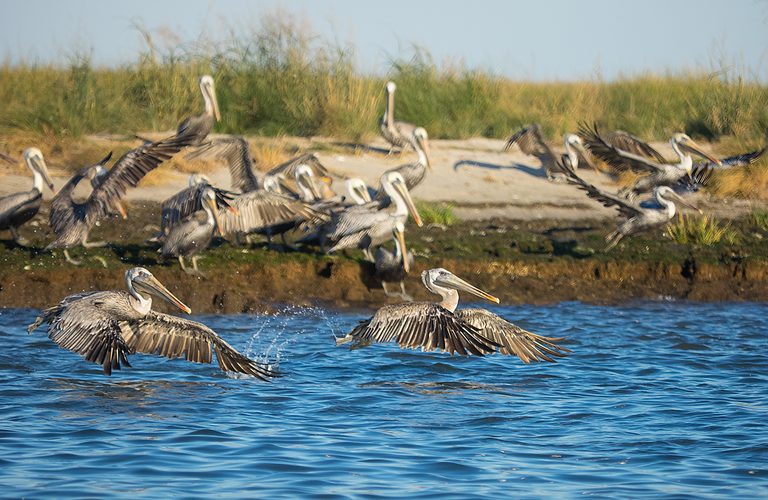
Scientists monitoring the Chesapeake Bay say the region’s brown pelican population has fallen by about half since its peak in the late 2000s, raising alarm among ornithologists and conservationists.
Local observations confirm sharp drop
Ornithologist Dave Brinker of the Maryland Department of Natural Resources noted, “They’re going down. That’s the simplest analysis.” He added that the birds’ sensitivity to prey availability points to changes in menhaden, a small fish that forms a key part of the pelicans’ diet.
Brown pelicans once flourished after the DDT ban, reaching nearly 3,000 breeding pairs around the Bay by the late 2000s. The most recent waterbird survey in 2023 recorded only about 1,500 pairs in Virginia’s portion of the Bay, a decline of roughly 20% from the earlier peak. Bryan Watts, director of the Center for Conservation Biology at the College of William and Mary, estimates the current population may be down 40‑50% overall, though he lacks the resources for a definitive study.
Menhaden fishery at the center of debate
Atlantic menhaden are harvested by Omega Protein, a Canadian firm that processes the fish into oil and meal for animal feed. Critics argue the “reduction fishery” has removed too many menhaden, leaving insufficient food for pelicans, ospreys and larger fish. Since 2018, federal managers have capped the Bay’s menhaden harvest at 51,000 metric tons per year, all taken from Virginia waters because Maryland prohibits the practice.
Conservation groups and recreational anglers are urging officials to lower that cap further. Recent declines in ospreys—evidenced by fewer eggs, emaciated chicks and starving nestlings—have also been linked to menhaden scarcity, though some scientists caution that the data are not yet conclusive.
Industry and scientists push back
Omega Protein’s spokesperson Ben Landry responded, “Before there is additional speculation in the media blaming the menhaden fishery, those suggesting a connection should produce peer‑reviewed evidence demonstrating that commercial menhaden fishing is responsible.” He also highlighted a separate study attributing the pelican decline on Shanks Island to steady erosion, not fishery impacts.
Reid Nelson, a fisheries scientist at George Mason University, echoed the need for more data, stating, “I don’t know that we have the data to support that yet, and I hope that’s where the new research goes.”
Local birding community feels the loss
Birding guide Jim Rapp, who leads tours to the Smith Island archipelago, recalled that Shanks Island once hosted nearly 2,000 nesting pelican pairs. “For a while, their numbers dwindled. In recent years, there have been none,” he said, noting the colony’s disappearance from his “bingo card.”
Watts suggested the island’s erosion may have forced the birds to relocate, but the new colonies have not compensated for the loss in numbers.
What comes next?
Both state wildlife agencies and federal fishery managers face pressure to gather more robust data on menhaden stocks and their ecological ripple effects. Brinker emphasized the broader implication, saying, “It’s a sign that the fisheries in the Chesapeake Bay are beginning to struggle.”
Without additional funding for research, scientists fear the decline could continue unchecked, potentially affecting other species that rely on the same food chain.
Original reporting: Baltimore Fishbowl — read the source article.