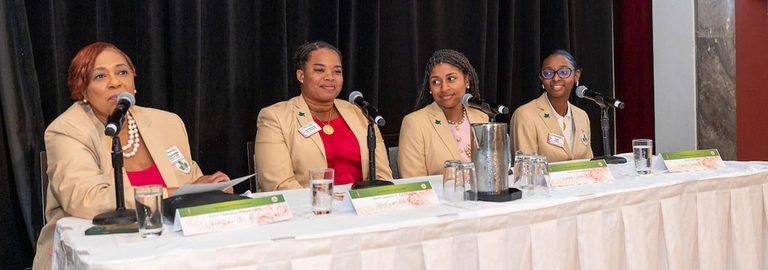
On November 14, Morgan State University in Baltimore will host Alpha Kappa Alpha Sorority’s Undergraduate Leadership Institute, placing hundreds of undergraduate women at the helm of the program. Graduate advisers will sit in the back of the room, offering guidance while allowing the students to run the event.
Why the shift matters
Dr. Tonja L. Ringgold, director of the sorority’s North Atlantic Region, first joined Alpha Kappa Alpha’s Alpha Delta Chapter in 1982. Forty‑four years later she returns to Morgan State not as a spectator but as a leader, eager to invest in the potential of today’s young women. The chapter, chartered in 1926, is celebrating its centennial, underscoring the sorority’s long‑standing commitment to mentorship.
Noah M.P. Harris, a senior at Bowie State University and president of the sorority’s Eta Chapter, was elected International Second Vice President this summer. As a member of the sorority’s international governing board, she brings student perspectives to decisions that affect the entire organization.
Challenging the “wait‑your‑turn” myth
Both women argue that leadership should not be a distant destination reserved for older generations. Alpha Kappa Alpha, founded in 1908 by Black college women, now counts more than 390,000 initiated members across over 1,122 chapters. That reach carries a responsibility to open doors, not merely preserve tradition.
Recent research supports this view. Deloitte’s 2026 global survey found that 76% of Gen Z respondents are interested in senior leadership roles eventually, even though only 6% named leadership their primary career goal. Many cited concerns about burnout and work‑life balance, suggesting they are questioning the conditions under which leadership is exercised rather than shunning it.
McKinsey and LeanIn.Org’s 2025 report highlighted persistent barriers for Black women: for every 100 men promoted to manager, only 60 Black women received the same advancement. Telling young women to wait does nothing to address this inequity.
Putting theory into practice
The Undergraduate Leadership Institute will have undergraduate members lead sessions, with graduate members offering expertise and mentorship from the back of the room. The sorority plans to extend this model to its 96th North Atlantic Regional Conference in March 2027, where undergraduates will work alongside graduate vice chairs on operations, programming, social activities, and logistics.
This approach emphasizes inclusion with influence. A seat at the table means little if participants cannot help shape outcomes. By pairing mentorship with meaningful assignments, organizations can empower emerging leaders while preserving the wisdom of seasoned members.
Lessons for the broader community
Businesses, colleges, nonprofits, and civic groups can adopt the same strategy: involve young leaders in decision‑making before finalizing plans, provide resources, and allow room for mistakes. When younger voices challenge familiar practices, leaders should ask whether those practices still serve their purpose.
The goal is not to pass the torch and walk away, but to expand the circle of empowered leaders, strengthening institutions for the future.
Dr. Tonja L. Ringgold serves as the North Atlantic regional director of Alpha Kappa Alpha Sorority, Incorporated. Noah M.P. Harris, a senior at Bowie State University, is the sorority’s International Second Vice President and president of its Eta chapter.
Original reporting: The Washington Informer — read the source article.