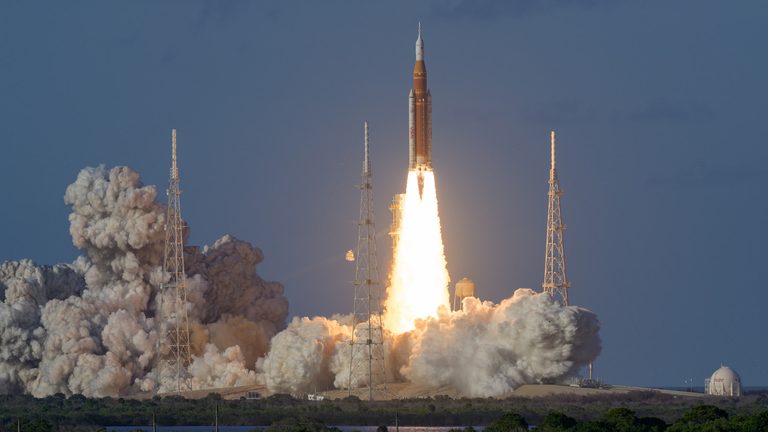
Researchers at Taiwan’s National Cheng Kung University have identified ionospheric disturbances caused by engine burns during NASA’s Artemis II mission that stretched over 3,100 miles across North America. The study, which analyzed data from roughly 3,500 ground stations receiving GPS and other satellite navigation signals, suggests these disturbances could introduce positioning errors of a few meters.
What the study found
The team tracked three distinct disturbances. The first occurred at liftoff from Kennedy Space Center on April 1. A stronger disturbance followed about two hours later when the rocket’s upper stage fired for roughly 18 minutes, raising the spacecraft’s orbit. The final disturbance happened on April 2 during Orion’s main‑engine burn that sent the crew toward the Moon. Both later burns released energy directly into the ionosphere, producing larger electron‑density shifts than the initial launch.
Changes in electron concentrations can delay navigation signals traveling to Earth, which may affect the calculated position of a receiver, according to the National Weather Service. Co‑author Charles Lin, an earth‑sciences professor at National Cheng Kung University, warned that a positioning error of a few meters could impact self‑driving cars and drones.
Implications and next steps
The researchers called for increased monitoring of such engine burns to better understand their effects on satellite navigation and radio communications. While the study does not yet quantify the exact impact on everyday GPS users, it highlights a potential vulnerability in the increasingly autonomous transportation sector.
Artemis II marked the first crewed lunar flyby in more than 50 years, with astronauts Reid Wiseman, Victor Glover, Christina Koch, and Canadian astronaut Jeremy Hansen aboard. The crew splashed down in the Pacific Ocean off San Diego on April 10 and returned to NASA’s Johnson Space Center in Houston on April 11.
Original reporting: WBAP News/Talk (Dallas-Fort Worth) — read the source article.