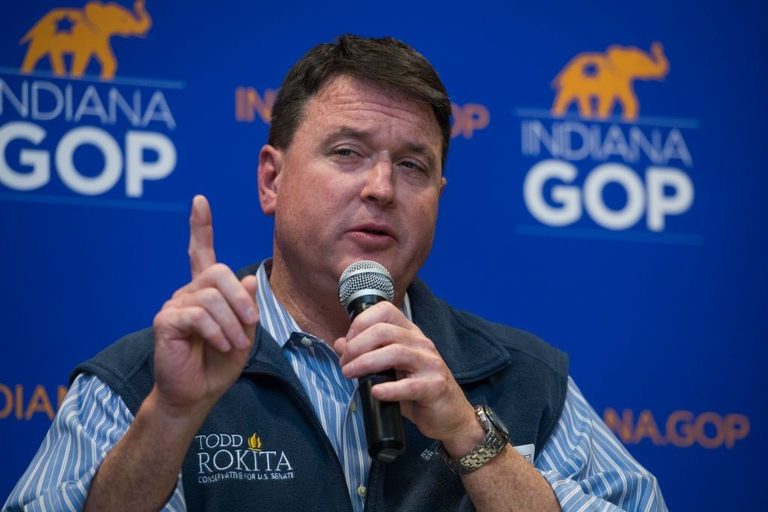
Indiana Attorney General Todd Rokita sharply criticized Hamilton County Sheriff-elect Charles Hollowell for ending the county’s 287(g) agreement with Immigration and Customs Enforcement (ICE). Rokita warned that the decision could jeopardize public safety by allowing illegal immigrants who are booked into the county jail to avoid ICE notification.
Sheriff‑elect’s plan
Hollowell, a Democrat, announced his intention to “get rid of” the 287(g) partnership, a program that authorizes trained jail staff to perform certain immigration enforcement duties and to notify ICE when an illegal immigrant is detained. By terminating the agreement, the county will no longer alert ICE when an illegal immigrant is booked, shifting all enforcement responsibility to local authorities.
Rokita’s response
Rokita called the move a “serious mistake” and a “reckless gamble with public safety.” He emphasized that Indiana has faced an “illegal immigration crisis” that was created by Democratic policies and that cooperation between sheriffs and ICE is essential to protect residents. “Ripping up the existing 287(g) agreement only weakens public safety and sends the exact wrong message,” Rokita said.
Local reaction
Community activist Tony Katz echoed the AG’s concerns, arguing that the decision places political and moral accountability on those who supported the sheriff‑elect. “If you’re going to elect a sheriff and the sheriff’s first statement is ‘I’m weak on crime,’ then it’s on you,” Katz said, adding that the blame for any future violent crime committed by an illegal immigrant would fall on Hollowell and the Democratic Party that backed him.
Katz challenged Hollowell to explain his plan for handling illegal immigrants in the county, offering an open invitation for the sheriff‑elect to appear on air and answer voters’ questions directly.
What the policy change means for Hamilton County
Without the 287(g) agreement, local law enforcement will no longer have a formal mechanism to forward illegal‑immigrant detainees to ICE. The county will need to develop its own procedures for addressing criminal non‑citizens, a task that critics say could stretch limited resources and create uncertainty for officers on the ground.
Broader context
The dispute reflects a larger statewide debate over immigration enforcement. Indiana’s Republican leadership has consistently advocated for strong cooperation with federal authorities, while some local officials argue for more autonomous, community‑focused policing. The outcome of this disagreement could set a precedent for other counties considering similar actions.
Next steps
Hollowell has not yet detailed an alternative strategy for dealing with illegal immigrants who commit crimes. Rokita and local law‑enforcement advocates are urging the sheriff‑elect to provide a clear plan before the new term begins. The conversation is expected to continue on local radio, at community forums, and in upcoming county board meetings.
Listeners can hear the full discussion on WIBC 93.1 FM or stream the segment online.
Original reporting: 93.1 WIBC (Indianapolis) — read the source article.